
Sales Infrastructure Report • 2026
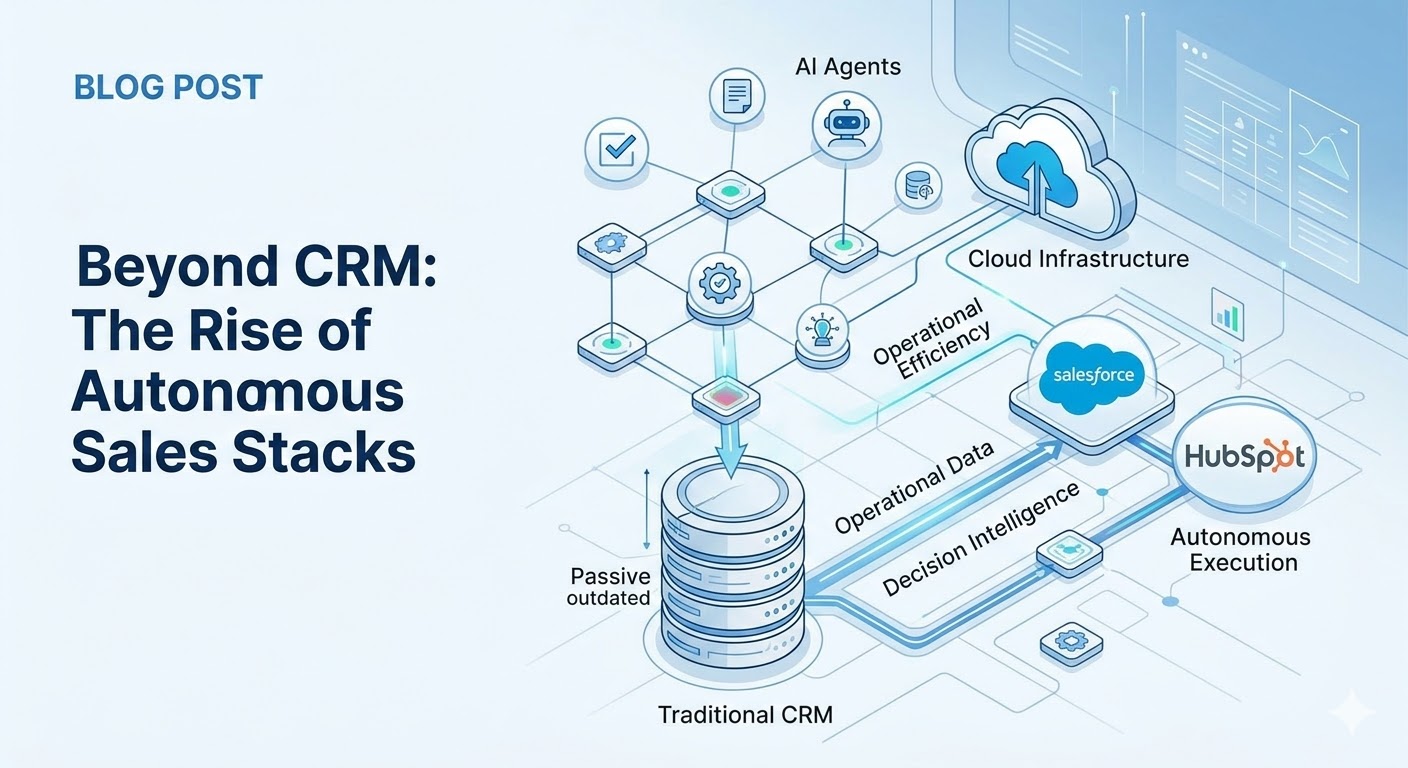
Strategic Map: 2026 Enterprise Sales Infrastructure Duality and Autonomous Agent integration.
SOURCE: EXPERT PRODUCT LAB ANALYSIS — INFRASTRUCTURE STRATEGY DIVISION.
The implementation of Autonomous Sales Stacks in 2026 marks the definitive point where traditional CRMs cease to be the final destination for data, evolving into a mere persistence layer. True competitive advantage has migrated toward these intelligent systems, where orchestration occurs across a liquid data mesh.
In practical terms, autonomous sales stacks are layered systems where CRMs act as interfaces and databases, while AI agents handle enrichment, routing, and decision-making across a shared data mesh. Instead of pushing every team to live inside a single UI, these stacks let humans supervise and correct what autonomous agents execute at scale.
CRM, hosting and e-commerce at enterprise scale, our
ROI Guide for CTOs 2026
maps the full software infrastructure ROI model for technical leaders.
In this Technical Audit:
1. Why Autonomous Sales Stacks Are Replacing Legacy CRM Monoliths
Traditionally, CRMs functioned as static Systems of Record. Today, the priority is the System of Agency. This means the modern sales infrastructure does not just store names; it executes end-to-end cognitive workflows—from lead enrichment via AI agents to real-time churn prediction.
According to recent analysis by the Forbes Technology Council, organizations failing to decouple their data layer from their CRM UI are facing a 30% increase in technical debt. Modern autonomous sales stacks are designed to bypass these bottlenecks.
Audit Highlights: Autonomous Stack Efficiency
- Data Liquidity: 40% reduction in sync latency between databases and LLMs.
- Agentic Readiness: Native integration with protocols like Salesforce Agentforce and HubSpot Breeze.
- Operational ROI: Elimination of manual data entry tasks, redirecting human capital to strategy.
2. Data Mesh Architecture in Modern Sales Operations
The rise of autonomous sales stacks is powered by a decentralized data mesh. Instead of a single monolithic database, 2026 infrastructure relies on specialized nodes for identity, intent, and engagement. As outlined in the IEEE standards for Autonomous Systems, interoperability is the key to scalability.
3. Evolution Matrix: Legacy CRM vs. Autonomous Sales Stacks
The matrix below is a practical way to diagnose where your current stack sits today. Most enterprises find themselves in a hybrid state: part legacy CRM, part autonomous capabilities stitched together with custom middleware.
| Strategic Attribute | Legacy CRM (2020–2024) | Autonomous Sales Stacks (2026+) |
|---|---|---|
| Human Role | Manual Data Entry | AI Agent Supervisor |
| Architecture | Monolithic Silo | Decoupled / Agent-Ready |
| Decision Latency | Days/Weeks (Batch BI) | Milliseconds (Real-time) |
a traditional CRM plus an emerging autonomous sales layer. The key is to design that layer so
agents can take over repetitive actions first, while humans stay focused on judgment calls and
high‑value conversations.
4. Calculating the ROI of Sales Automation Infrastructure
Investing in autonomous sales stacks is a core infrastructure play. The ROI is measured by the “Cost per Successful Action” (CPSA) rather than seat-based pricing. Transitioning to these systems is the only way to maintain enterprise agility in the agentic era.
For sales and revops leaders working mostly from distributed teams, the physical environment also matters. See our 2026 guide on the best home office setup for founders and digital agencies.