B2B SaaS Strategy Report • 2026
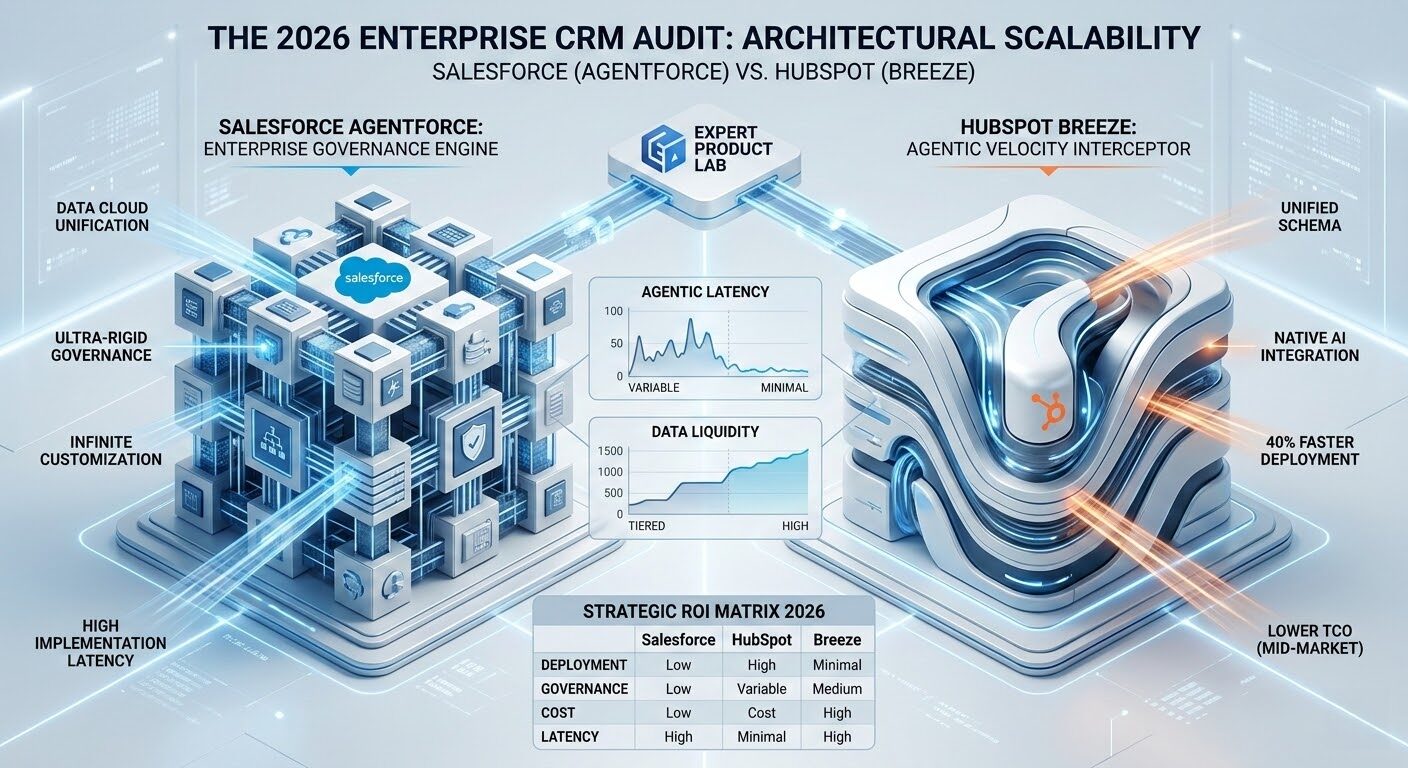
Strategic Map: The 2026 Agentic CRM Architectural Duality.
SOURCE: EXPERT PRODUCT LAB ANALYSIS — TECHNICAL UTILITY DIVISION.
Audit Highlights: Salesforce vs HubSpot 2026
- Salesforce Agentforce: Best-in-class for high-governance and complex data silos.
- HubSpot Breeze: Leader in agentic velocity and unified data schema.
- Focus: Evaluating Data Liquidity and Agentic Latency ROI.
In this Salesforce vs HubSpot 2026 audit, we explore how the CRM landscape has hit a fundamental inflection point. Customer Relationship Management has evolved from a cloud-hosted spreadsheet to a core infrastructure decision. As the industry shifts toward Autonomous Agent Orchestration, the “database era” has officially transitioned into the “action era,” where static records are replaced by autonomous workflows.
From a practical standpoint, this means leadership teams are no longer choosing between two interfaces. They are deciding which agentic engine will sit at the center of their revenue data mesh, and how quickly that engine can turn signals into action without creating new silos or technical debt.
follows the same evidence-based framework described in our
Research Methodology.
We stress-test API resilience, data liquidity, and agentic latency before assigning
any ROI verdict to either platform.
1. The Great Decoupling: From Databases to Agentic Engines
Leading enterprises are shifting from a “System of Record” to a “System of Agency.” High API latency or siloed data now leads to operational failure in the Modern Enterprise Architecture.
In our broader work on autonomous sales stacks, we have seen that the CRM is no longer the final destination for data. It is one of several execution layers where AI agents operate, supervised by humans but no longer constrained by single-vendor UI paradigms.
2. Data Liquidity: The Silent ROI Killer
Our technical audit found that Salesforce Agentforce requires a robust Data Cloud setup to achieve high liquidity, whereas HubSpot Breeze leverages its unified schema for immediate agentic action.
In practice, this means Salesforce can be the superior choice for highly regulated, multi-entity environments, but only when the organization is ready to invest in a full Data Cloud architecture. HubSpot often delivers faster time-to-value for teams that need agentic workflows up and running within weeks instead of quarters.
3. Strategic Salesforce vs HubSpot 2026 ROI Matrix
The matrix below simplifies how we communicate trade-offs to boards and investment committees. It is not meant to pick a universal “winner,” but to clarify which CRM is structurally better aligned with a given growth stage and governance profile.
governance, HubSpot Breeze usually wins on deployment speed and agentic velocity.
In late-stage or highly regulated environments, Salesforce Agentforce typically
pulls ahead once a full Data Cloud and governance layer are in place.
| Metric | Salesforce (Agentforce) | HubSpot (Breeze) |
|---|---|---|
| Deployment Velocity | Low (3–9 Months) | High (2–4 Weeks) |
| Data Governance | Tier 1 (Ultra-Rigid) | Tier 2 (Standard) |
| Agentic Latency | Variable | Minimal (Unified) |
4. CTO Verdict — When to Choose Each Platform
For high-governance enterprises with complex data silos, Salesforce Agentforce
becomes the superior choice once a dedicated Data Cloud and architecture team are in place.
The platform shines when you need granular permission models, cross-entity reporting, and
strict compliance enforcement at global scale.
For fast-moving teams that prioritize deployment speed, unified data, and lower
implementation overhead, HubSpot Breeze typically delivers a higher near-term ROI.
Its native schema, marketing-sales alignment, and out-of-the-box agentic workflows make it
ideal for companies that need results in weeks, not quarters.