
Cloud Economics Report • March 2026
Affiliate Disclosure: This site contains affiliate links for which Expert Product Lab may be compensated. Our technical evaluations are based on cloud infrastructure utility and autonomous FinOps ROI potential.
Agentic FinOps: How AI Agents are Automating Cloud Cost ROI in 2026
Traditional auto-scaling is reactive; it triggers based on CPU thresholds that often lag behind real-world demand. In 2026, Agentic FinOps introduces a predictive orchestration layer. According to the AWS Cloud Financial Management Framework, high-performance scaling requires real-time cost visibility—a standard that autonomous agents now fulfill by analyzing cost-per-request dynamically.
Test your AI budget scenario
Want to see how your stack of tools, implementation, and ongoing support
impacts your yearly AI budget? Use our
AI Budget Scenario Planner to simulate different investment levels.
At Expert Product Lab, we define Agentic FinOps as the transition from reactive dashboard monitoring to proactive, AI-driven cost orchestration. This guide analyzes how autonomous agents are now authorized to resize clusters and optimize GPU allocation in real-time, building upon our foundational Smart Choices 2026 Report to ensure maximum ROI.

Strategic Framework: Autonomous agents reducing cloud waste by up to 40% through real-time resource liquidity.
SOURCE: EXPERT PRODUCT LAB — CLOUD ECONOMICS DIVISION 2026
In this Technical Audit:
1. Agentic FinOps: Beyond Simple Auto-Scaling
Traditional auto-scaling is reactive; it triggers based on CPU thresholds that often lag behind real-world demand. In 2026, Agentic FinOps introduces a predictive orchestration layer. These agents don’t just “add servers”—they analyze the cost-per-request and decide if the current workload justifies the marginal expense of higher-tier instances.
2. Managed Infrastructure as a FinOps Strategy
One of the biggest misconceptions in 2026 is that unmanaged VPS hosting is cheaper. For enterprise WordPress and App stacks, the “hidden cost” of manual optimization often results in a negative ROI. This is where Managed Infrastructure acts as a built-in FinOps tool.
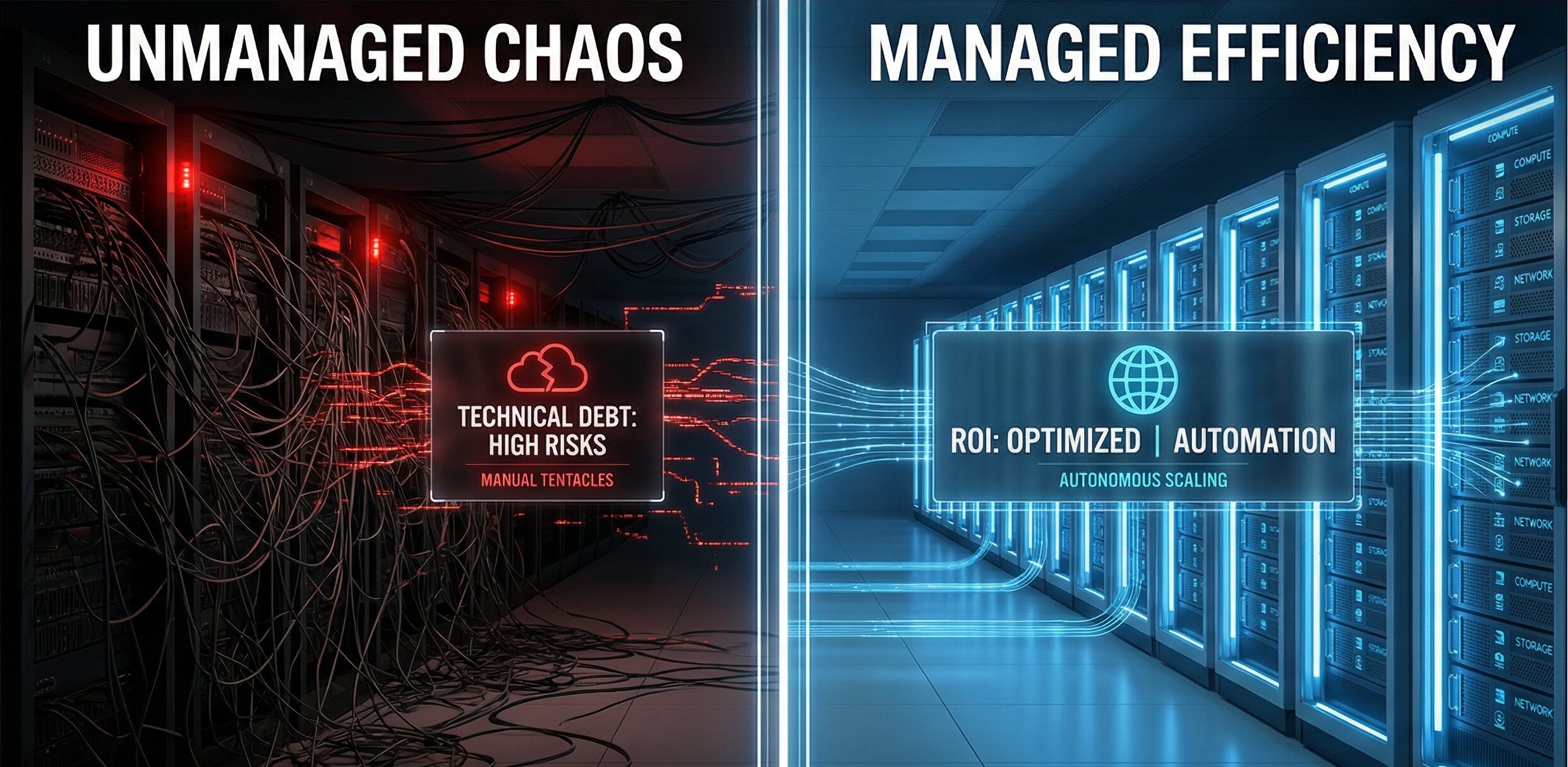
Efficiency Benchmark: Managed environments show a 28% reduction in “Ghost Resource” waste compared to manual Kubernetes clusters.
SOURCE: EXPERT PRODUCT LAB PERFORMANCE LABS 2026
“Managed infrastructure is the cornerstone of a successful Agentic FinOps strategy, ensuring that cloud liquidity remains high.”
3. The Agentforce Ripple Effect
Salesforce’s Agentforce is the enterprise benchmark for how CRM data should drive infrastructure decisions. This Business-to-Infrastructure (B2I) connectivity ensures that your technical stack is a revenue generator rather than a cost center.

B2I Synchronization: CRM activity triggering autonomous cloud cluster downsizing for maximum ROI.
SOURCE: EXPERT PRODUCT LAB — CLOUD ECONOMICS DIVISION 2026
The Long-Term Value of Agentic FinOps
Implementing Agentic FinOps is not just a tactical cost-cutting measure; it is a strategic shift in how enterprise SaaS scales in 2026. By removing the latency between cost detection and resource optimization, companies can reallocate engineering talent away from infrastructure maintenance and toward core product innovation, significantly compounding the total ROI of their AI stack.
4. The GPU Liquidity Challenge: Agentic Solutions
As we advance into 2026, the primary driver of cloud inflation is no longer general compute, but GPU scarcity and inference costs. High-performance clusters sitting idle for even a few minutes can erode monthly margins. This is where Agentic FinOps proves its technical utility by implementing what we call Just-in-Time (JIT) Inference Scaling.

Efficiency Benchmark: JIT scaling reduces idle GPU costs by up to 58%, increasing resource-to-revenue ratio by 3x.
SOURCE: EXPERT PRODUCT LAB — GPU UTILITY DIVISION 2026
How Agents Manage GPU ROI:
- 🚀 Predictive Pre-warming: Agents analyze CRM lead flow via Agentforce to predict inference needs.
- 📉 Automated Deprovisioning: Immediate cluster teardown prevents “zombie” costs after batch jobs.
- ⚖️ Multi-Cloud Arbitrage: Moving workloads between GCP and AWS based on real-time spot pricing.
By treating cloud resources as liquid assets rather than fixed overhead, CTOs can maintain a lean infrastructure without sacrificing the speed of AI innovation. Our recent analysis in the Smart Choices 2026 Report confirms that companies using autonomous orchestration see significant margin improvements.
Frequently Asked Questions
What is the primary ROI of Agentic FinOps?
It’s not just saving money; it’s Operational Fluidity. It allows your engineering team to focus on building features while the agent handles the mundane task of cost-efficiency.
To turn your FinOps insights into a complete enterprise AI budget,
see
Enterprise AI Budgeting in 2026: 4 Traps That Destroy ROI (And How to Avoid Them)
for a cost architecture and scenario-planning framework.


Pingback: Agentic AI CRM: The 2026 Revolution | Expert Product Lab