
AI Infrastructure & Strategic Budgeting • 2026
Affiliate Disclosure: This site contains affiliate links for which Expert Product Lab may be compensated if you make a purchase. Our technical evaluations are driven by real-world system resilience, database logic, and long-term total cost of ownership (TCO).
Enterprise AI budgeting 2026 is no longer a theoretical exercise. It demands a realistic view of licensing, implementation engineering, and ongoing maintenance costs before any automation project reaches the boardroom.
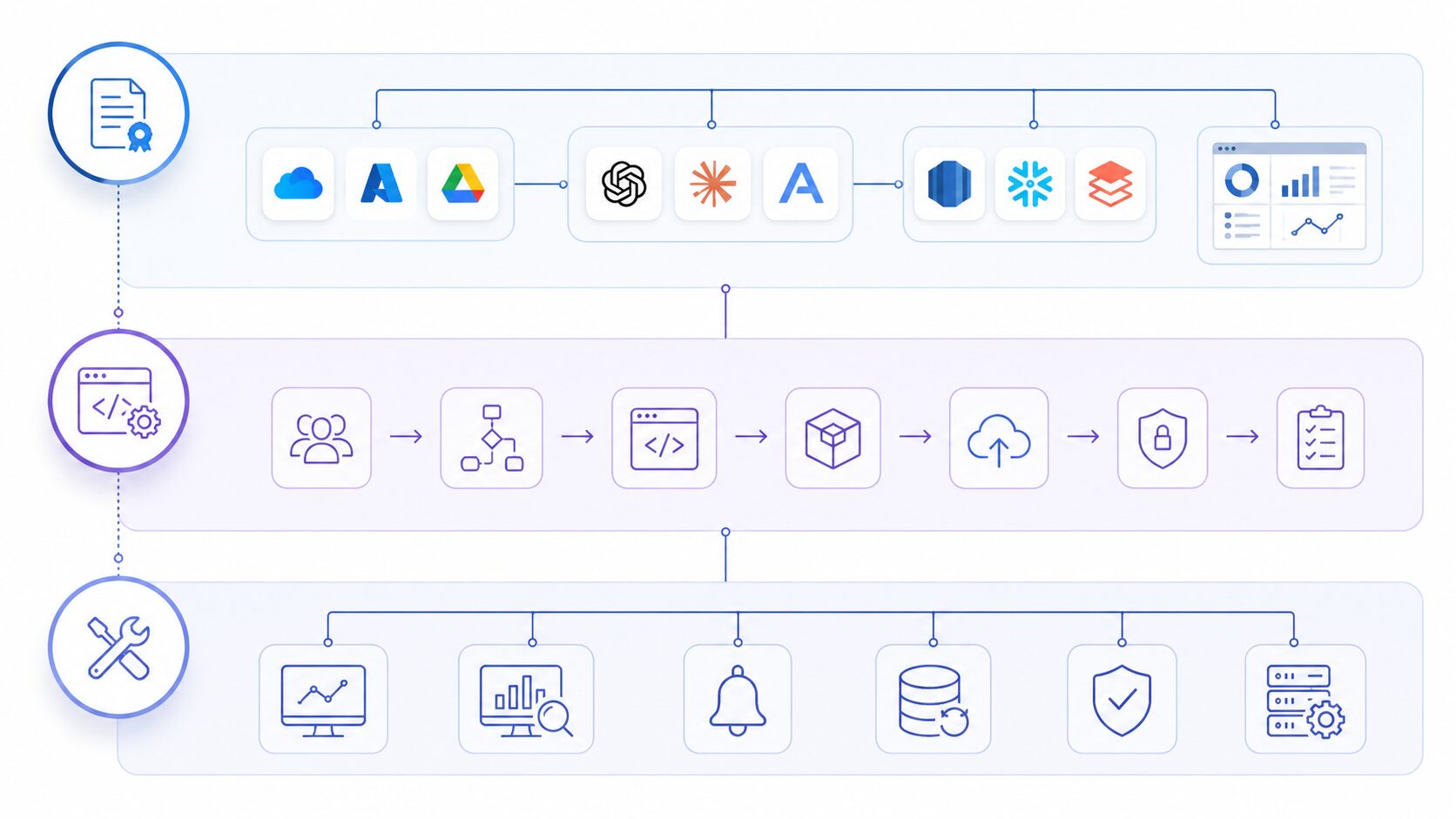
The Real Cost Architecture: Licensing, implementation engineering, and ongoing maintenance form the three structural layers of a resilient AI budget.
SOURCE: EXPERT PRODUCT LAB ANALYSIS — INFRASTRUCTURE DIVISION
Enterprise AI Budgeting in 2026: How to Build a Budget That Survives Real-World Constraints
In the current corporate landscape, artificial intelligence has successfully transitioned from an experimental “innovation line item” to a core infrastructure requirement. Yet, a glaring friction point remains: the vast majority of AI budgets are architected to fail. Executive teams routinely build financial models that treat advanced AI adoption as a simple software acquisition, assuming that total expenses begin and end with per-seat tool licensing or API token fees.
The reality on the ground is far more complex. When an organization ignores the operational friction of custom systems engineering, data preparation, workforce change management, and continuous performance upkeep, they don’t buy an automation solution—they buy compounding technical debt. Two distinct archetypes dominate corporate evaluation cycles today: the ambitious B2B SaaS founder eager to deploy an autonomous agentic stack to capture market share, and the pragmatically exhausted head of operations at a mid-market enterprise, currently buried under a graveyard of isolated pilot projects that never managed to scale. Both profiles face the exact same barrier: moving beyond executive hype and translating strategic intent into a resilient, boardroom-proof financial framework.
This audit delivers an analytical breakdown of the hidden financial constraints that break corporate planning. By isolating the structural traps that turn promising AI initiatives into unmanageable cost centers, technology leadership can transition away from speculative spending and construct an AI budget built to survive strict fiscal scrutiny, operational constraints, and board-level review.
Table of Contents:
1. The 4 Fatal AI Budget Traps Destroying ROI
To insulate your capital allocation from unpredictable project drift, technology and financial leaders must explicitly avoid four common structural traps that routinely compromise enterprise software deployments. Treat these traps as a practical diagnostic lens: use your ROI modeling tools and budget scenario planner not just as calculators, but as stress-test engines for every proposed automation initiative.
To insulate your capital allocation from unpredictable project drift, enterprise AI budgeting in 2026 must explicitly avoid four common structural traps that routinely compromise software deployments.
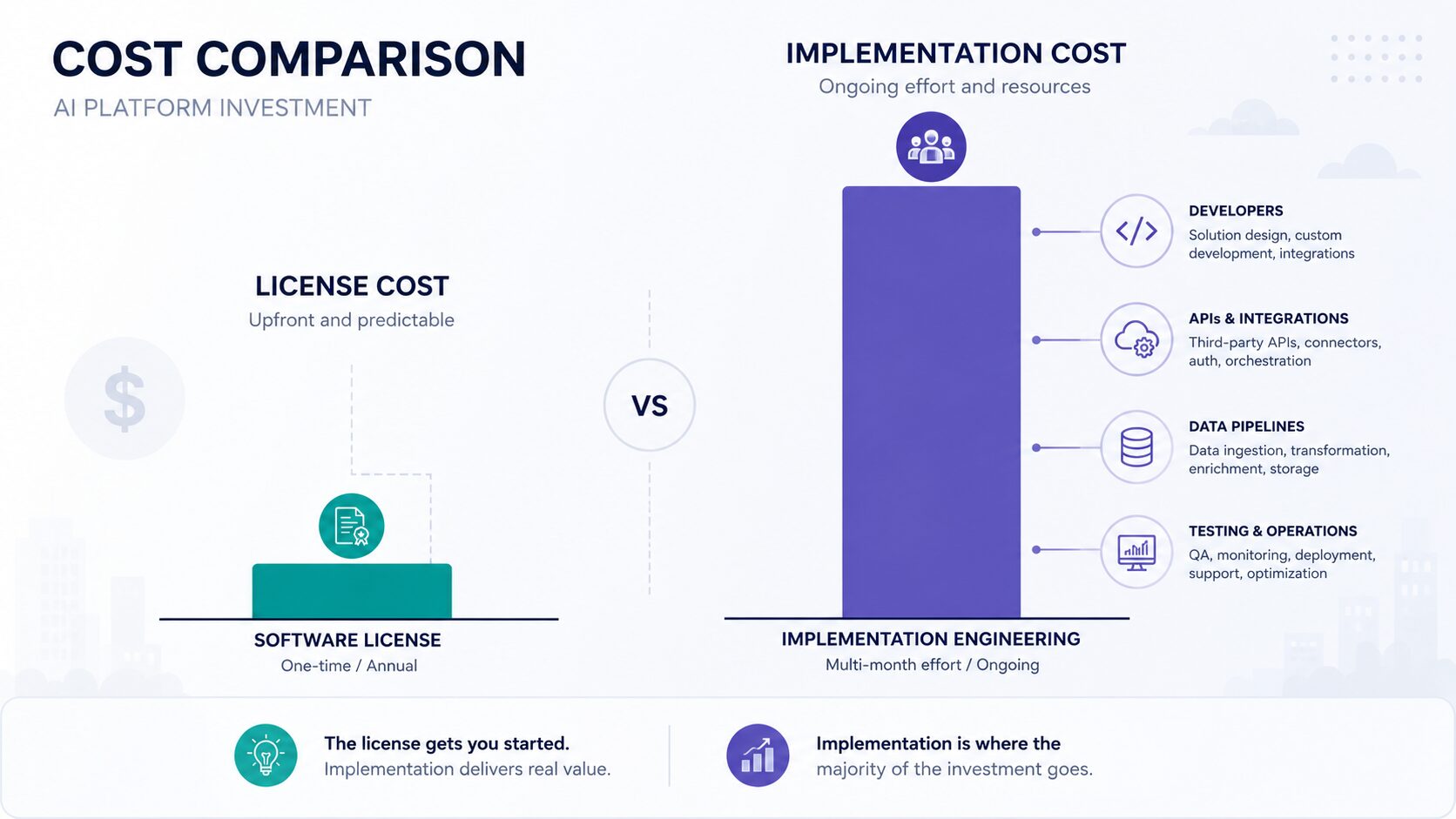
License Illusion: In most deployments, implementation engineering and data integration quickly outgrow the apparent simplicity of headline software fees.
SOURCE: EXPERT PRODUCT LAB — COST STRUCTURE MODELING
Trap 1: Counting Only Licenses, Ignoring Implementation and Ramp-Up
The most frequent error in early-stage software modeling is equating headline SaaS pricing with the total cost of deployment. Because platform sales teams emphasize low per-user entry tiers or cheap baseline API access, buying committees fail to calculate the sheer volume of technical labor required to connect an advanced model to real internal corporate data environments.
Consider a scaling enterprise that approves a new customer service agent infrastructure purely because the software license is an accessible $2,000 per month. Within ninety days, the project stalls because the system requires extensive custom backend API engineering, vector database indexing, clean data restructuring, and weeks of dedicated data cleansing. Suddenly, the initial approved budget is overrun by a factor of three, driven entirely by internal engineering hours, external system integrators, and implementation consulting fees.
How to escape: Transition to an all-inclusive framework that tracks internal developer allocations and professional configuration hours alongside base platform fees. Structuring your initial procurement with a clean, unified software blueprint ensures that configuration realities are fully accounted for before capital is committed.
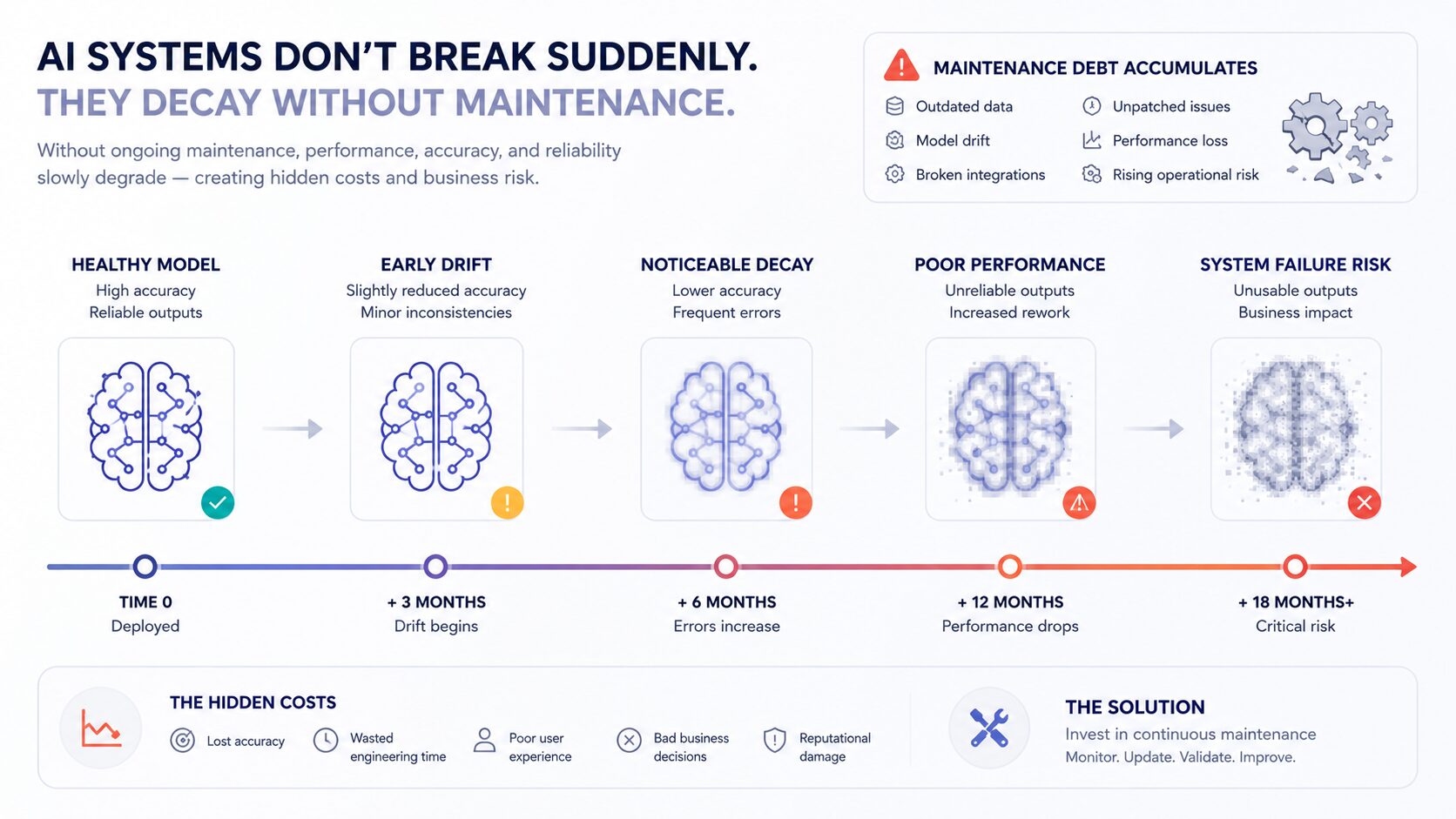
Maintenance Debt: Without explicit sustenance lines in the budget, AI systems drift, degrade, and eventually become too brittle to maintain in production.
SOURCE: EXPERT PRODUCT LAB — MAINTENANCE RISK ANALYSIS
Trap 2: Underestimating Sustainment and “AI Maintenance Debt”
A corporate budget is highly vulnerable to the myth of the “one-and-done” software deployment. While traditional software systems can remain operational for quarters with standard patch updates, autonomous AI models are uniquely dynamic, requiring continuous human intervention to prevent performance degradation, broken context matching, and data drift over time.
A classic corporate scenario unfolds: an organization launches a highly successful inbound sales qualification agent in Year 1, celebrating immediate speed-to-lead velocity gains. By Year 2, however, performance degrades significantly because nobody allocated a clear, dedicated line item for prompt library optimization, fine-tuning, vector data updating, or monitoring third-party vendor API model updates. The system becomes brittle, customer-facing outputs drift from brand guidelines, and the platform is eventually abandoned due to a lack of structured maintenance capital.
How to escape: Treat long-term system maintenance as a non-negotiable operational cost. Every approved initiative must feature an ongoing sustenance allocation to fund continuous log analysis, prompt engineering, and database hygiene management.
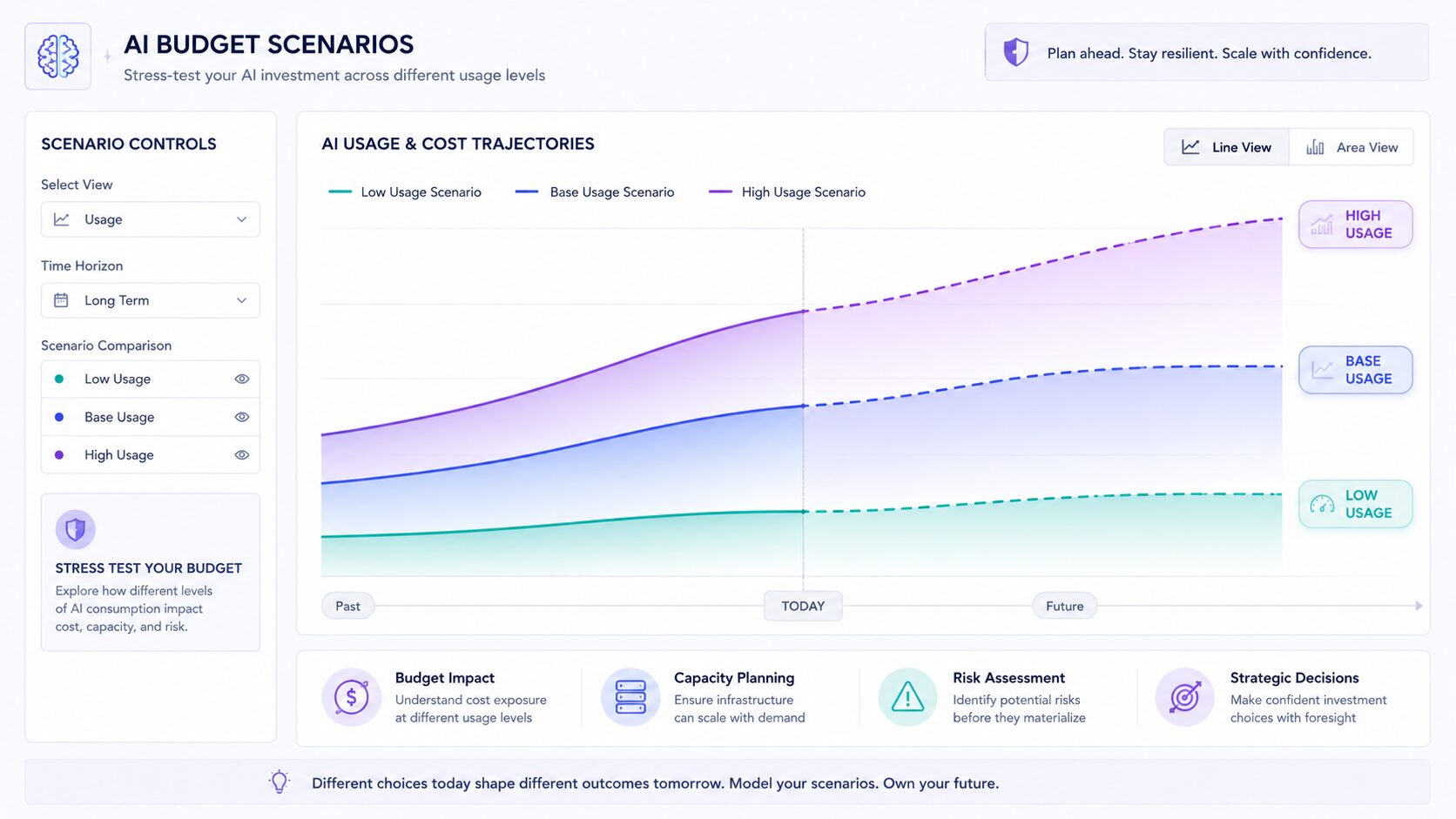
Scenario Bands: Low, base, and high usage projections give leadership the elasticity needed to absorb real-world consumption spikes.
SOURCE: EXPERT PRODUCT LAB — AI BUDGET SCENARIO FRAMEWORK
Trap 3: No Scenario Planning (The Dangerous “Best-Case” Budget)
Many technology teams present the executive suite with a rigid, single-line budget forecast built entirely on idealized assumptions. They project uniform data usage, static query volumes, and flawless deployment velocities, leaving no financial elasticity for the unpredictable realities of consumption-based scaling.
When an enterprise deploys an autonomous operations model across multiple departments without setting strict usage boundaries, a sudden traffic spike or an unpredicted surge in data processing requests can trigger catastrophic consumption overages. Within a single billing cycle, a model projected to cost $5,000 monthly can spike into a five-figure financial liability, forcing financial leadership to abruptly freeze critical operations to contain cost overruns.
How to escape: Never build a financial model based on a single best-case projection. Technology leadership must construct three clear operational bands: a Low-Scale Pilot model, a Base-Case departmental expansion projection, and a High-Scale enterprise volume limit. Utilizing a dedicated AI Budget Scenario Planner allows teams to simulate these distinct resource consumption bands and ensure the organization is never caught blind by scaling overages.
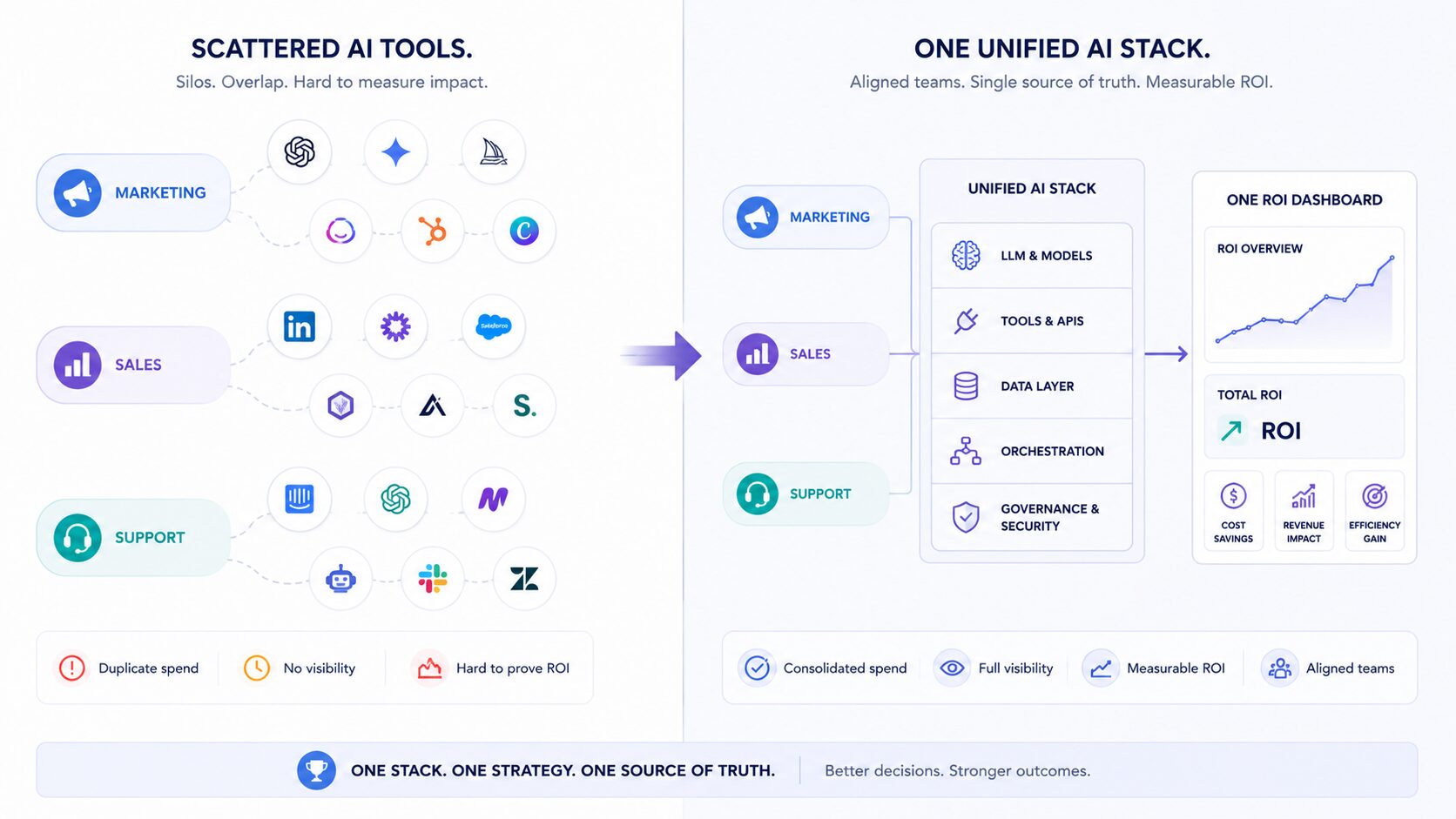
Scattered vs Unified Spend: Siloed tool purchases erode financial clarity, while a centralized ROI narrative protects the automation stack from cuts.
SOURCE: EXPERT PRODUCT LAB — CROSS-DEPARTMENTAL ROI MODEL
Trap 4: Splitting AI Budget Across Teams with No Shared ROI Narrative
When an enterprise lacks centralized technical governance, individual business units begin procuring isolated AI tools in complete silos. Marketing acquires copy generation wrappers, outbound sales buys isolated automated sequencing platforms, and customer success deploys detached triaging widgets. This results in a massive accumulation of scattered spend with zero unified financial justification.
When the Chief Financial Officer initiates a fiscal review, these uncoordinated software assets are viewed as redundant operational waste rather than a unified strategic asset. Because individual departments lack a common, data-backed methodology to articulate how their separate tools reduce processing hours, lower customer acquisition costs, or capture leaked revenue, the entire collective stack faces immediate cancellation during budget consolidation cycles.
How to escape: Establish a rigorous, standardized financial framework that unifies cross-departmental automation investments under a single corporate return narrative. Utilizing an advanced tool like our interactive Agentic AI ROI Calculator allows disparate teams to translate qualitative time-savings into clear, standardized financial metrics—such as net monthly value captured and return per dollar invested—insulating vital software lines from corporate cost cuts.
| Budget Trap | The Operational Root Cause | The Strategic Escape Path |
|---|---|---|
| 1. License Illusion | Ignoring custom backend API and data integration labor | Incorporate internal dev hours into initial capital modeling |
| 2. Maintenance Debt | Underestimating model drift and prompt library upkeep | Mandate dedicated ongoing sustenance budget allocations |
| 3. Blind Scaling | Modeling single-line, static best-case scenarios | Deploy a multi-band AI Budget Scenario Planner |
| 4. Scattered Spend | Siloed procurement without unified performance tracking | Unify software acquisition through a centralized ROI metric |
2. The Strategic AI Budget Checklist
Before submitting an AI or automation proposal to the executive board or approving a department purchase order, confirm that your project team can answer these four foundational technical requirements:
- Did you account for full implementation engineering? Map the exact human hours required for custom database connection, data preparation, workflow structuring, and internal user training.
- Is there an explicit, multi-year sustenance line item? Ensure there is dedicated capital allocated specifically for ongoing log monitoring, system fine-tuning, and handling model updates.
- Have you simulated at least three scaling bands? Verify that the financial plan accounts for a clear pilot stage, an expanded mid-tier model, and an absolute high-scale enterprise consumption limit.
- Is the workflow justification backed by a credible financial narrative? Ensure the projected savings are translated into clear, auditable performance variables rather than vague promises of “increased efficiency.”
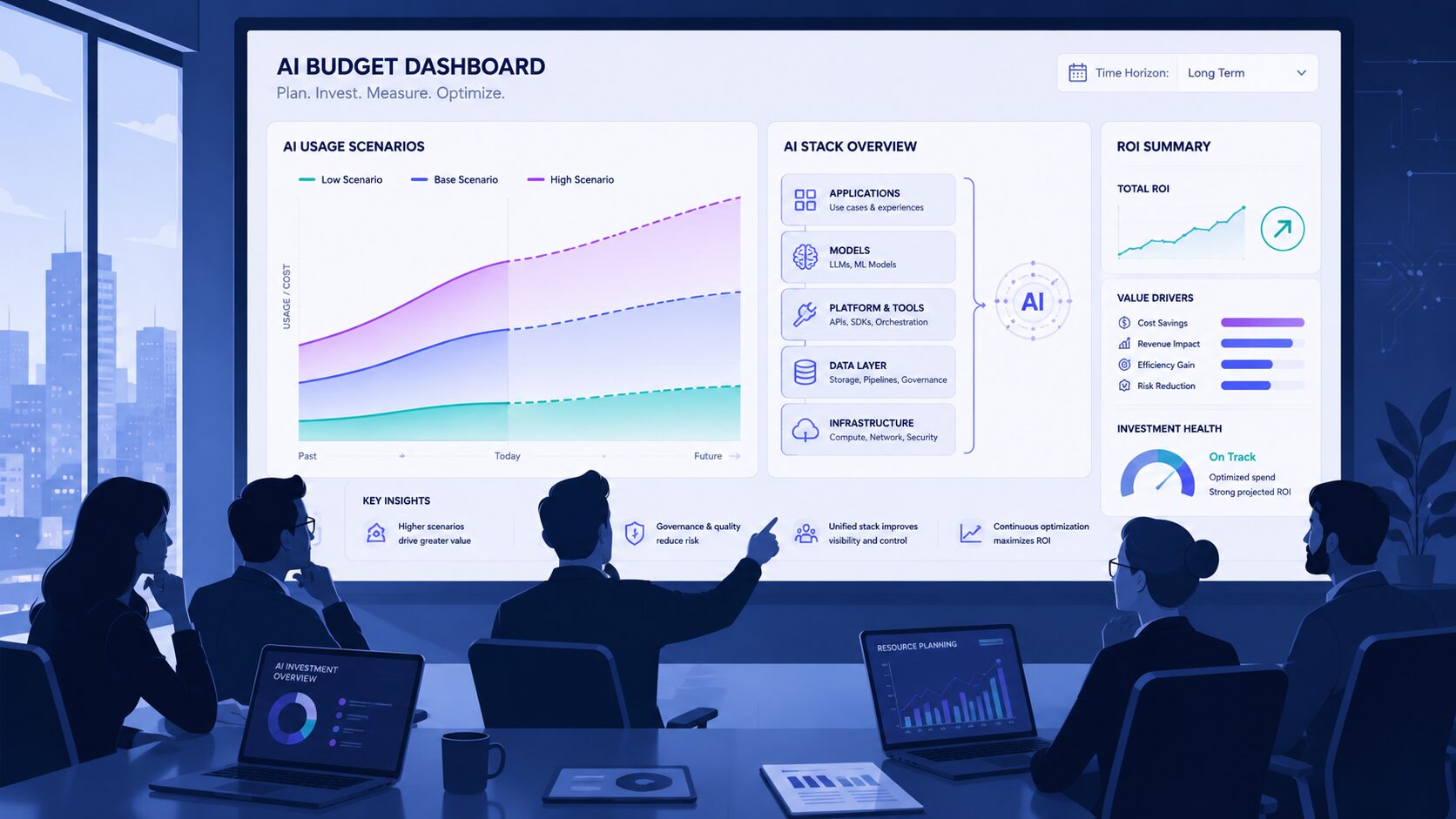
The CTO Verdict: Treat AI budgeting as financial architecture, combining ROI modeling and scenario planning before any large-scale deployment.
SOURCE: EXPERT PRODUCT LAB — STRATEGIC BUDGETING PANEL
3. The CTO Verdict: Turning Constraints into Compounding Assets
An AI budget built to survive the constraints of 2026 must be treated as a rigorous exercise in financial architecture rather than speculative experimentation. The companies that capture genuine competitive advantages this year are those that run their automation initiatives through the exact same financial scrutiny as major database migrations or infrastructure overhauls.
An AI budget built to survive the constraints of 2026 must be treated as a rigorous exercise in financial architecture. Enterprise AI budgeting in 2026 is ultimately about turning technical ambition into a stable, compounding revenue driver.
Do not allow your automation strategy to become scattered across uncoordinated departmental lines. Use our interactive Agentic AI ROI Calculator to instantly determine if a proposed workflow deserves an independent budget line item based on credible personnel savings metrics. Pair that data with our multi-band AI Budget Scenario Planner to simulate data consumption overages before you deploy a single live instance. By wrapping technical ambition in a highly resilient, data-backed financial model, you transform your software stack from a volatile operational expense into a stable, compounding revenue driver.
4. Frequently Asked Questions
In standard enterprise software deployments, the hidden engineering cost of implementation often ranges from 2x to 3x the baseline software subscription price. If an autonomous agentic platform lists at $5,000 per year, expect to invest between $10,000 and $15,000 in internal development labor, system configuration, database cleaning, and custom integration architecture to achieve true production reliability.
The only reliable methodology is mapping user interaction data through strict volume bands. Calculate baseline historical inquiry counts, factor in maximum growth variables, and explicitly simulate transaction rates through a multi-band scenario model. Setting clear hard limits on commercial API keys and configuring real-time alert boundaries prevents unexpected scaling spikes from altering your monthly financial plans.
Most pilot projects are built within a controlled sandbox using ideal data variables and minimal system stress. When these applications face real-world enterprise constraints—such as legacy software architecture, fragmented data inputs, and shifting regulatory models—the lack of continuous system sustenance and operational maintenance resources causes the infrastructure to stall before achieving enterprise adoption.



Pingback: ROI Guide for CTOs 2026: Maximizing Enterprise Software Infrastructure
Pingback: Research Methodology 2026 - expertproductlab.com
Pingback: Agentic FinOps: 5 Powerful Ways AI Agents Automate Cloud ROI in 2026
Pingback: AI Budget Prioritization 2026: What Enterprise Teams Should Fund First
Pingback: Best Productivity Gadgets for Enterprise Workers (2026)
Pingback: Enterprise Work Setups: Ergonomic Guide (2026) | EPL
Pingback: Hardware Standardization for Hybrid Work (2026)