ROI & Strategy • 2026
Affiliate Disclosure: This site contains affiliate links for which Expert Product Lab may be compensated if you make a purchase. Our evaluations focus on real-world usability, ROI impact, and fit for founders and digital agencies.
The 2026 Founder Stack: How Hosting, Home Office, and AI Workflows Shape Your Real Capacity
Most founders still think in terms of individual tools: a hosting provider here, a CRM there, a few AI apps sprinkled on top. In 2026, that mindset quietly caps growth. What actually matters is the system of work you operate inside every day — the stack that shapes how quickly you can think, ship, and sell.
Across Expert Product Lab audits with founders, digital agencies, and small B2B teams, three layers show up again and again: infrastructure, environment, and automation. Together, they form what we call the 2026 Founder Stack — the combination of hosting, home office, and AI workflows that defines your real capacity, not just your software list.

Founder Stack Map: Infrastructure, environment, and AI workflows working together.
SOURCE: EXPERT PRODUCT LAB STRATEGY UNIT
Table of Contents:
When you look at hosting, home office, and AI as one connected stack instead of separate shopping lists, you start to see where capacity is leaking: slow sites that lose deals, setups that shorten your focus blocks, and “smart” tools that never quite turn into repeatable workflows.
1. Why your founder stack matters in 2026
Founders and agency leaders now spend most weeks inside the same loop: deep work, client calls, async updates, and quick decisions. A weak stack turns that loop into constant micro-friction — slow dashboards, unstable calls, and manual follow-ups that never end. A strong stack quietly removes those points of friction so your effort goes into strategy, creative work, and high-value conversations.
The 2026 Founder Stack is less about owning “the best tool” in each category and more about how the layers interact. Infrastructure keeps your public face fast and reliable, your environment keeps you physically and mentally able to do the work, and your AI workflows keep the operational load from overwhelming you as the business grows.

Infrastructure Layer: Where your pipeline, content, and revenue actually live.
SOURCE: EXPERT PRODUCT LAB CLOUD & HOSTING UNIT
2. Layer 1 – Infrastructure: where your revenue actually runs
Your infrastructure layer is the part of the stack that prospects and clients touch before they ever talk to you: websites, landing pages, portals, and all the integrations that hang off them. For many founders, this layer is built on WordPress — which means your choice of hosting behaves like a revenue decision, not an IT line item.
In Best WordPress Hosting 2026: Kinsta vs WP Engine vs Cloudways — The CTO-Grade Audit, we treat hosting the same way a CFO would treat a core vendor: speed, reliability, and long-term cost of ownership. A cheap plan that slows TTFB and hurts Core Web Vitals is expensive once you factor in lost conversions, support tickets, and brand damage.
For technical teams and agencies, there is a second asset inside this layer: the home lab. As we map in Best Mini PCs for Home Lab 2026, a small cluster of capable mini PCs lets you test containers, new WordPress stacks, and AI workloads without touching production, so experimentation does not risk client revenue.
3. Layer 2 – Environment: the home office as execution engine

Environment Layer: A home office tuned for deep work and client-facing calls.
SOURCE: EXPERT PRODUCT LAB WORK SETUPS UNIT
Infrastructure decides what is possible; your physical environment decides what is likely. A founder running an agency or SaaS from home is effectively working from a control room. Screen real estate, ergonomics, and audio-video quality quietly determine how long you can think clearly and how credible you look to clients.
In Best Home Office Setup for Founders and Digital Agencies 2026, we treat monitors, chairs, desks, lighting, and audio as capacity multipliers. The right layout keeps dashboards, docs, and creative tools visible at the same time, protects your back and neck during long stretches, and makes every call feel like a deliberate touchpoint rather than a compromise forced by “working from home”.
mesh ergonomic office chair on Amazon
is closer to infrastructure than decoration — it supports long deep-work blocks and reduces the physical tax you pay for every extra client.
4. Layer 3 – AI workflows: from scattered tools to systems of action
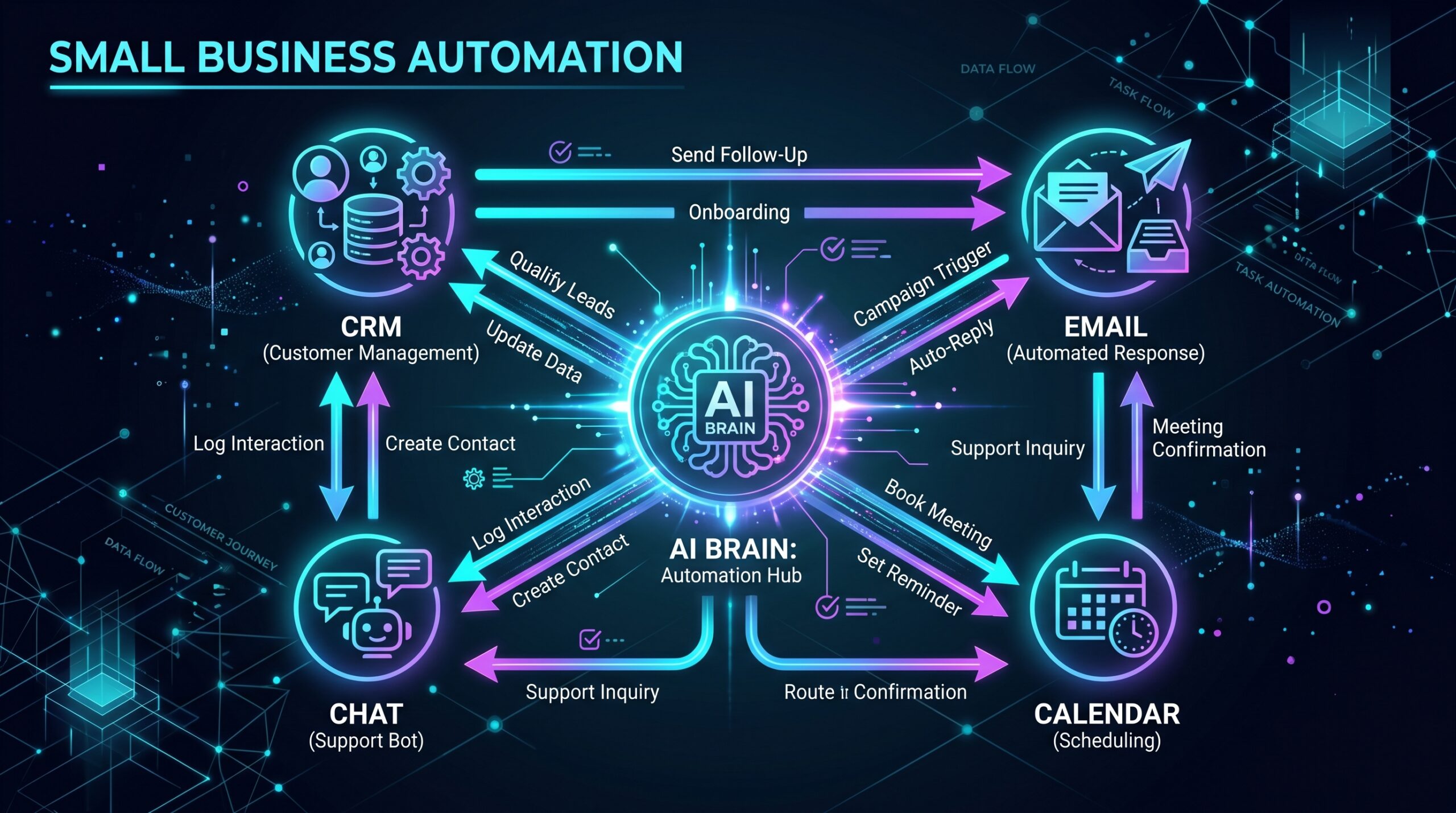
Automation Layer: AI workflows turning data into concrete next actions.
SOURCE: EXPERT PRODUCT LAB AI SYSTEMS UNIT
The final layer of the 2026 Founder Stack is not which AI tools you subscribe to, but how those tools are wired into repeatable workflows. Most small businesses already sit on top of AI features inside CRMs, email platforms, design tools, and chat systems. The real gap is orchestration — getting those capabilities to work together in ways you can trust and measure.
Best AI Tools for Small Business 2026 — Top 10 Ranked by Use Case focuses on the core jobs most teams actually need done: lead handling, content support, meeting capture, support triage. Best AI Workflow Stack for Small Business 2026 goes one level deeper by mapping how those tools can be chained into agentic workflows that move deals, content, and support forward without constant human babysitting.
5. Designing your 2026 Founder Stack on purpose

Strategy Snapshot: A one-page view of the founder stack for team alignment.
SOURCE: EXPERT PRODUCT LAB STRATEGY UNIT
Seen together, these three layers describe something simple but easy to ignore: your results in 2026 are shaped less by individual software choices and more by the quality of the stack you operate inside every day. Infrastructure, environment, and AI workflows either amplify each hour you work — or quietly tax it.
- Your infrastructure determines how fast and reliably your digital front door responds when prospects and clients show up.
- Your environment decides how much real thinking you can do before your body and attention give up.
- Your AI workflows define how much of your process is manual effort and how much is systematized, visible, and compoundable.
Founders who treat these decisions as a coherent stack — revisited deliberately once or twice a year — tend to pull ahead, not because they work more hours, but because each hour sits inside a system that amplifies it. The 2026 Founder Stack is the lens that keeps those decisions coordinated instead of reactive.