Cloud & Hosting • 2026
Affiliate Disclosure: This site contains affiliate links for which Expert Product Lab may be compensated if you make a purchase. Our technical evaluations are based on infrastructure utility, scalability, and enterprise ROI potential.
Kinsta vs WP Engine 2026: The Enterprise WordPress Hosting Audit
For enterprise teams running mission-critical WordPress infrastructure, the hosting decision is no longer a cost line — it is a revenue architecture decision. A 200ms improvement in TTFB can increase conversion rates by up to 2.4%. In 2026, the two platforms that define the premium managed WordPress tier are Kinsta and WP Engine.
At Expert Product Lab, we evaluate both platforms through a CTO lens: infrastructure design, scalability under load, true cost of ownership, and long-term technical debt implications.
Enterprise Hosting Audit: Kinsta vs WP Engine — Infrastructure, Performance and ROI Analysis for 2026.
SOURCE: EXPERT PRODUCT LAB ANALYSIS — CLOUD INFRASTRUCTURE DIVISION
Table of Contents:
1. Infrastructure Architecture
The fundamental difference between Kinsta and WP Engine begins at the infrastructure layer — and this difference has direct implications for latency, security isolation, and scalability.
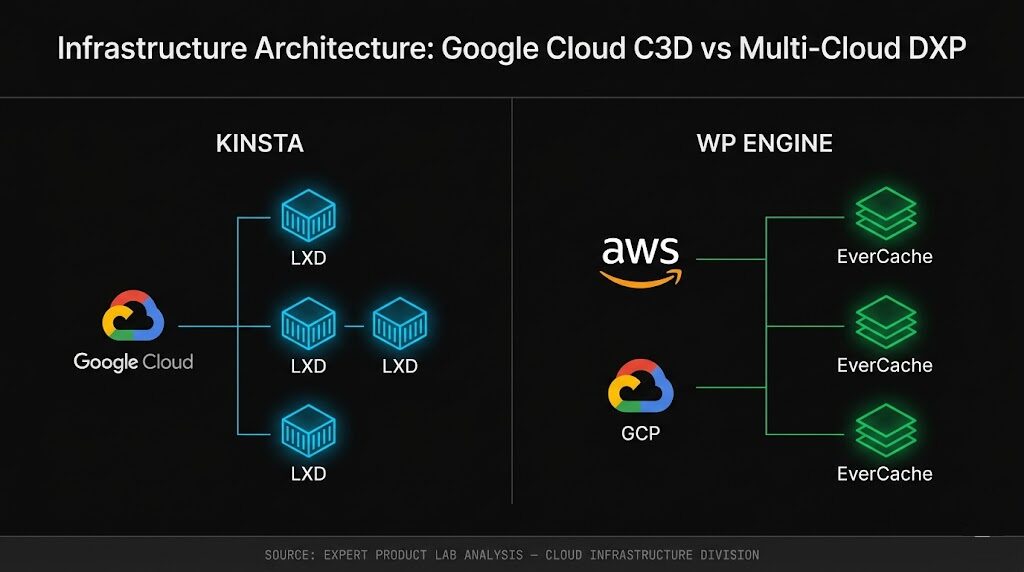
Infrastructure Architecture: Google Cloud C3D LXD Container Isolation (Kinsta) vs Multi-Cloud EverCache DXP (WP Engine).
SOURCE: EXPERT PRODUCT LAB ANALYSIS — CLOUD INFRASTRUCTURE DIVISION
Kinsta: Google Cloud C3D + LXD Container Isolation
Kinsta runs exclusively on Google Cloud Platform’s Premium Tier Network, leveraging C3D machine series for compute. Each WordPress site is deployed inside an isolated LXD container, eliminating the “noisy neighbor” syndrome common in shared and even some managed environments. With 37 global data centers and 260+ Cloudflare PoPs for edge delivery, Kinsta’s architecture is purpose-built for low-latency global delivery.
- Isolated LXD Containers: Each site runs in its own secure environment — no resource contention between accounts.
- Google Premium Tier Network: Traffic stays on Google’s private backbone, not the public internet, reducing latency significantly.
- Auto-scaling: Resources scale automatically during traffic spikes without manual intervention.
WP Engine: Multi-Cloud Digital Experience Platform (DXP)
WP Engine has evolved beyond hosting into a full Digital Experience Platform, running on a multi-cloud architecture spanning AWS and Google Cloud. Its proprietary EverCache® technology handles millions of simultaneous requests, and its Smart Plugin Manager uses AI-driven visual regression testing to safely automate plugin updates — a significant operational advantage for enterprise teams managing large WordPress fleets.
- EverCache® Technology: Proprietary caching layer optimized specifically for WordPress at scale.
- Genesis Framework + Headless Options: Full support for headless WordPress via WPGraphQL, enabling decoupled frontend architectures.
- Global Edge Locations: Multi-region cluster access with automated failover.
2. Performance Benchmarks
Raw performance benchmarks in 2026 consistently show Kinsta leading in TTFB (Time to First Byte) and Core Web Vitals scores, largely due to Google Cloud’s infrastructure advantage and LXD container isolation. Independent tests place Kinsta’s average TTFB at 180–220ms versus WP Engine’s 280–340ms on comparable plans.
According to Kinsta’s performance documentation,
TTFB directly impacts Core Web Vitals scores and Google Search rankings.
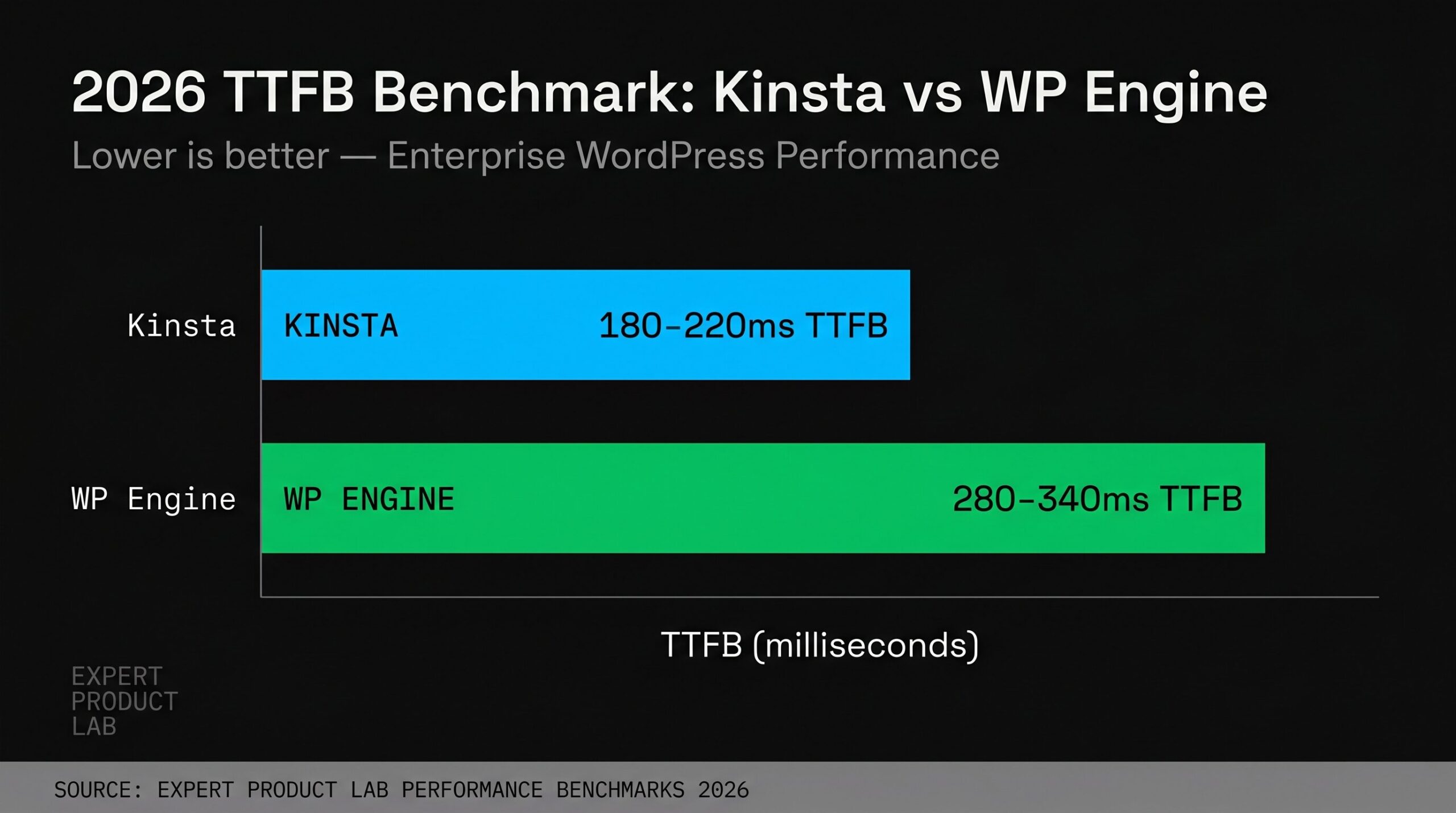
Performance Benchmarks: 2026 TTFB comparison — Kinsta (180–220ms) vs WP Engine (280–340ms). Lower is better.
SOURCE: EXPERT PRODUCT LAB PERFORMANCE BENCHMARKS 2026 — TECHNICAL UTILITY DIVISION
| Performance Metric | Kinsta | WP Engine |
|---|---|---|
| Average TTFB | 180–220ms | 280–340ms |
| Uptime SLA | 99.9% | 99.99% |
| CDN Edge Locations | 260+ (Cloudflare) | Global Cluster |
| Auto-scaling | ✅ Native | ✅ Native |
| PHP Version Control | ✅ Full control | ✅ Full control |
| Staging Environment | ✅ All plans | ✅ All plans |
Kinsta’s edge caching reduces TTFB by up to 50% across
300+ global PoPs, while delivering up to 200% faster speeds
compared to WP Engine on equivalent plans — a measurable infrastructure
advantage that directly impacts Core Web Vitals scores and organic search
rankings in 2026.
3. Pricing & True Cost of Ownership
Entry-level pricing is deceptively similar — Kinsta starts at $35/month and WP Engine at $30/month. However, the true cost of ownership diverges significantly at the enterprise tier, where infrastructure decisions, overage policies, and support costs create material differences.
| Pricing Factor | Kinsta | WP Engine |
|---|---|---|
| Entry Plan | $35/month (1 site) | $30/month (1 site) |
| Enterprise Plans | Custom pricing | Custom pricing |
| Overage Policy | Flexible, no surprise bills | Hard overage charges |
| Free Migration | ✅ Included | ✅ Included (1 site) |
| Money-back Guarantee | 30 days | 60 days |
| Multisite Management | MyKinsta Dashboard | User Portal |
4. Support & Enterprise SLA
At the enterprise level, support response time is a direct operational risk metric. Kinsta’s support team — composed exclusively of WordPress engineers — delivers average first-response times under 2 minutes via live chat, 24/7. WP Engine offers dedicated account management and phone support on enterprise plans, which is a significant advantage for large teams managing complex deployments.
- Kinsta: 24/7 expert support via live chat, avg. response <2 min, no tiered support gatekeeping.
- WP Engine: 24/7 chat + phone on enterprise plans, dedicated account manager, onboarding assistance.
Recommended reading: WordPress performance
If you want to go deeper into the principles behind fast, scalable WordPress sites
(beyond just picking a host), check out
WordPress Website Performance: How To Optimize Your WordPress & WooCommerce
Website To Achieve Top Traffic and Business Results.
👉 Get the book on Amazon
5. Full Comparison Matrix
| Criteria | Kinsta | WP Engine | Winner |
|---|---|---|---|
| Infrastructure | Google Cloud C3D | Multi-cloud AWS/GCP | 🏆 Kinsta |
| Performance (TTFB) | 180–220ms | 280–340ms | 🏆 Kinsta |
| Uptime SLA | 99.9% | 99.99% | 🏆 WP Engine |
| Container Isolation | ✅ LXD Native | ⚠️ Partial | 🏆 Kinsta |
| Headless/DXP Support | ⚠️ Partial | ✅ Full DXP | 🏆 WP Engine |
| Agency/Multisite | ✅ Strong | ✅ Industry-leading | 🏆 WP Engine |
| Support Speed | <2 min avg. | Tiered by plan | 🏆 Kinsta |
| Pricing Transparency | ✅ Clear | ⚠️ Overage risk | 🏆 Kinsta |
| Money-back | 30 days | 60 days | 🏆 WP Engine |
6. CTO Verdict — When to Choose Each
7. Frequently Asked Questions
In independent benchmark tests, Kinsta consistently delivers lower TTFB (180–220ms vs 280–340ms) due to its exclusive use of Google Cloud’s Premium Tier Network and LXD container isolation. For performance-critical enterprise sites, Kinsta holds a measurable edge.
WP Engine has a stronger ecosystem for agency-scale management, offering dedicated account managers, white-label options, and a more mature multisite management portal. Kinsta’s MyKinsta dashboard is excellent but WP Engine’s agency tooling is more mature.
For a business generating $500K+ annually, one hour of downtime or a 300ms latency disadvantage can cost more than a full year of premium hosting. Both platforms justify their pricing through infrastructure reliability, expert support, and operational tools that reduce internal DevOps overhead.
Yes, but WP Engine offers a more complete headless DXP stack, including native WPGraphQL support, Atlas framework, and dedicated headless infrastructure. Kinsta supports headless deployments but is less opinionated about the frontend stack.