Strategy & Infrastructure Report • April 2026
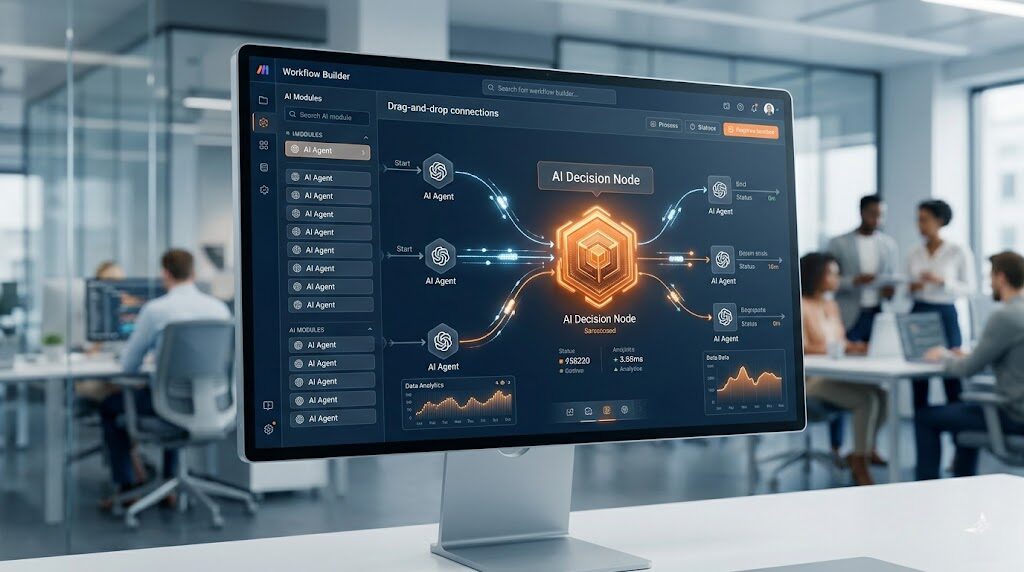
Interface Logic: Orchestrating multiple AI Agents in a unified Action Layer.
SOURCE: EXPERT PRODUCT LAB — ARCHITECTURE & SYSTEMS DIV. 2026
Agentic Workflows have fundamentally redefined the boundaries of enterprise productivity in 2026. Until recently, automation was confined to rigid, pre-defined pathways: “If This, Then That.” However, in today’s volatile digital landscape, this linear approach has become a critical bottleneck. As generative AI continues to saturate the market, the true competitive advantage has shifted from simple task execution to orchestrating complex decisions through resilient, autonomous digital ecosystems.
agentic workflows are rooted in the same DevOps philosophy documented in
The DevOps Handbook by Gene Kim, Jez Humble, Patrick Debois,
and John Willis — the award-winning guide used by Google, Amazon, and Netflix
to deploy thousands of changes per day with world-class reliability and security.
(Amazon affiliate link)
The Efficiency Gap between legacy systems and modern infrastructures is widening at an exponential rate. Leading organizations are no longer satisfied with static bots; they are demanding iterative reasoning capabilities. This means deploying systems that can evaluate context, reflect on outcomes, and adjust their own logic in real-time. This is not just automation; it is the construction of a self-evolving Technical ROI engine designed for the next decade of business growth.
Budget layer for this stack: If you’re planning to turn this 2026 enterprise stack into a real investment plan, don’t stop at license fees. Our new Enterprise AI Budgeting Framework: Tooling, Implementation & Sustenance (2026) maps the full cost architecture across support, marketing and finance — including rollout scenarios from pilot to full operation.
1. Orchestration vs. Automation: The Strategic Divide
Understanding the difference between automation and orchestration is vital for any CTO managing a 2026 budget. While automation handles a single, repetitive task, orchestration acts as a master conductor, synchronizing multiple systems (CRM, ERP, and Cloud stacks) to achieve high-level business goals. We have entered the age of Decision Intelligence, where the system itself determines the most efficient path to a conversion.

Digital Symphony: Visualizing the transition from passive data storage to autonomous enterprise execution layers.
SOURCE: EXPERT PRODUCT LAB — ARCHITECTURE & SYSTEMS DIV. 2026
By drastically reducing Lead-to-Execution Time, an AI Orchestrator can handle nuances that would paralyze a traditional script. Imagine an agent that identifies a discrepancy in an enterprise contract, cross-references it with historical legal precedents in your Data Lake, and automatically prepares a Slack brief for the legal team. This isn’t just a “time-saver”—it’s a risk mitigation strategy powered by Agentic Workflows.
2. Low-Code: The Backbone of High-Performance Systems
The myth that robust enterprise systems must be built exclusively with proprietary code is dead. In 2026, Low-Code platforms provide the essential “Action Layer” for the world’s most sophisticated Systems of Action. These platforms offer three non-negotiable advantages for the modern enterprise:
- Operational Agility: Scaling complex integrations in hours rather than months, allowing for rapid pivoting in response to market shifts.
- Governance and Auditability: Real-time visualization of data flows ensures that compliance and security protocols are never bypassed.
- Reduced Technical Debt: By leveraging standardized Low-Code blocks, companies can scale their Agentic Workflows without ballooning their internal engineering costs.
Expert Recommendation
For those ready to deploy their first “Action Layer,” we highly recommend Make.com. Its visual logic and API resilience make it the gold standard for orchestrating professional Agentic Workflows.
3. Architecture for 2026: The Three-Layer Stack
Effective Strategic Ecosystem Management requires a tiered approach to infrastructure. At Expert Product Lab, we advocate for a 3-layer architecture that separates data from execution to prevent system-wide failures:
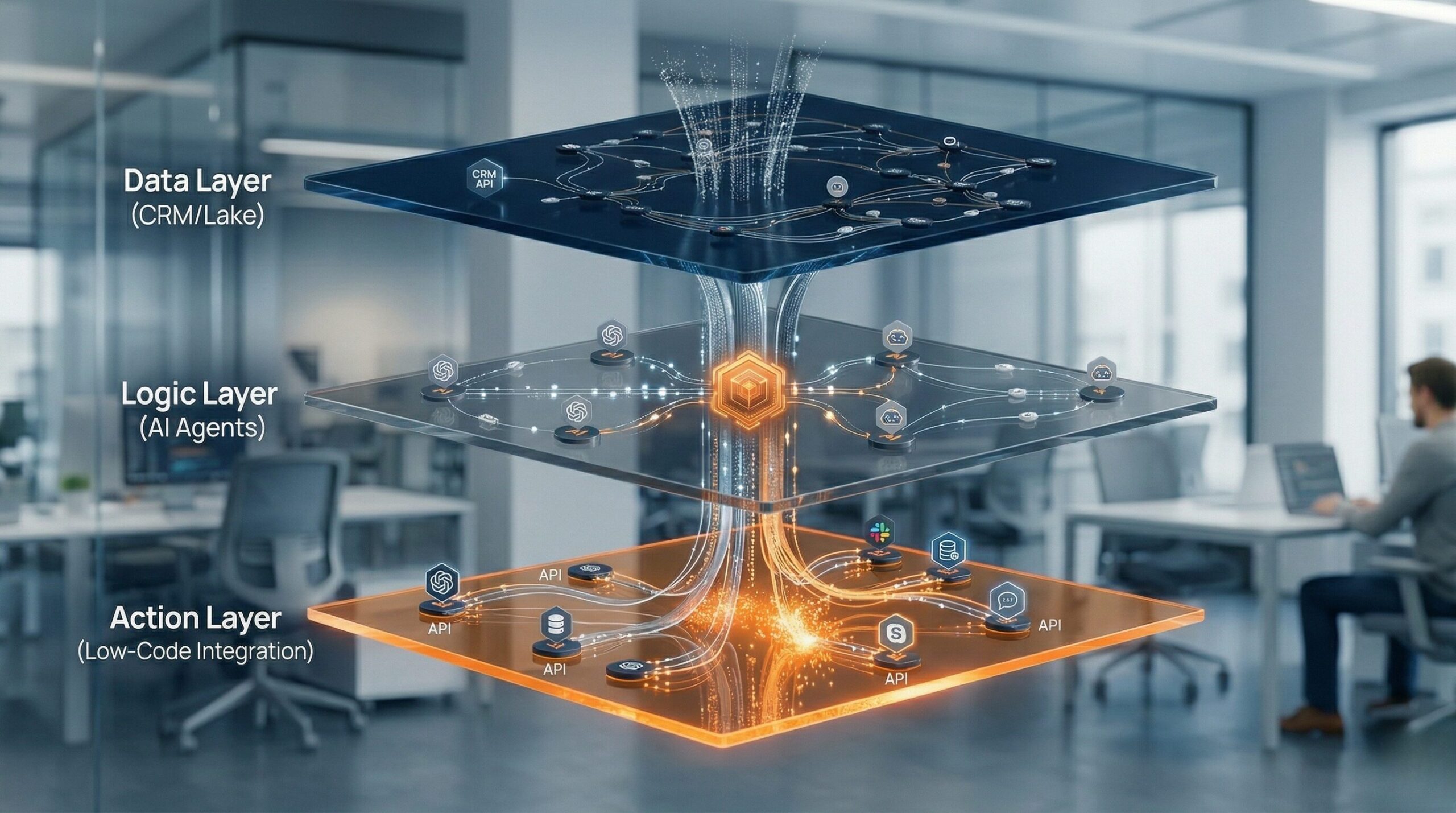
Structural Shift: Visualizing the transition from passive data storage to autonomous enterprise execution layers.
SOURCE: EXPERT PRODUCT LAB — ARCHITECTURE & SYSTEMS DIV. 2026
- Data Layer (Core Intelligence): The centralized repository (CRM or Data Lake) that feeds the system verified, real-time information.
- Logic Layer (AI Agents): The “brain” where Agentic Workflows process data, apply iterative reasoning, and select the best course of action.
- Action Layer (Execution): The Low-Code integration plane where decisions are turned into tangible API calls and business results.
4. Self-Healing Systems and Autonomous Governance
The next frontier of Agentic Workflows is the “Self-Healing” system. By utilizing Error Handling Automation, modern workflows can identify a failed API connection and autonomously attempt a secondary route or pivot to a backup provider without human oversight. This level of resilience is what separates an amateur automation from an enterprise-grade ecosystem.
Furthermore, autonomous governance ensures that as your AI agents make decisions, they stay within pre-defined ethical and financial guardrails. By monitoring Cloud ROI Metrics in real-time, the Logic Layer can automatically scale down high-cost processes during low-traffic periods, ensuring that your Technical ROI is always optimized for maximum profitability.
Conclusion: Leading the Execution Revolution
In 2026, automation is no longer a tool; it is your organization’s central nervous system. Implementing Agentic Workflows is a mandatory step for any business that wishes to transform from a passive data repository into an aggressive, autonomous execution engine. By bridging the gap between data and action, you aren’t just saving time—you are architecting the future of your enterprise.