ROI Strategy • 2026
The Hybrid Work Technology Budget: What Enterprise Teams Should Standardize, Upgrade, and Stop Buying
A hybrid work technology budget should not treat laptops,
peripherals, software licenses, and AI tools as isolated expenses. Learn how
enterprise teams can prioritize technology investments for stronger operational
reliability and measurable ROI in 2026.

A technology budget is an operating model, not a purchase list.
Hardware, peripherals, support, software, and AI should be prioritized as
connected parts of the same productivity system.
Expert Product Lab Visual Analysis • 2026
The False Economy of Cheap Hardware
Many companies buy laptops, docks, headsets, software licenses, and artificial
intelligence tools as if they were completely separate expenses. The structural
problem with this approach is that, without a disciplined prioritization model,
organizations accumulate disconnected tools, create a growing number of
operational exceptions, and make it difficult to prove return on investment.
The lowest purchase price on an invoice does not necessarily produce the lowest
operating cost. Saving money on a generic dock, or allowing each department to
purchase its own AI subscriptions without governance, creates a less visible
cascade of costs: more IT tickets, slower onboarding, unreliable executive
meetings, duplicated software, and avoidable downtime.
In 2026, technology investment is moving beyond broad adoption toward disciplined
governance. A modern budget needs a clear order: standardize the baseline, fix
recurring friction, upgrade only by work profile, and stop buying isolated tools.
a measurable operational constraint—not simply because it is newer, cheaper, or
more feature-rich.
The Four Layers of a Hybrid Work Budget
To build a total cost of ownership model that can withstand finance review,
technology leaders should organize spending across four interdependent layers.
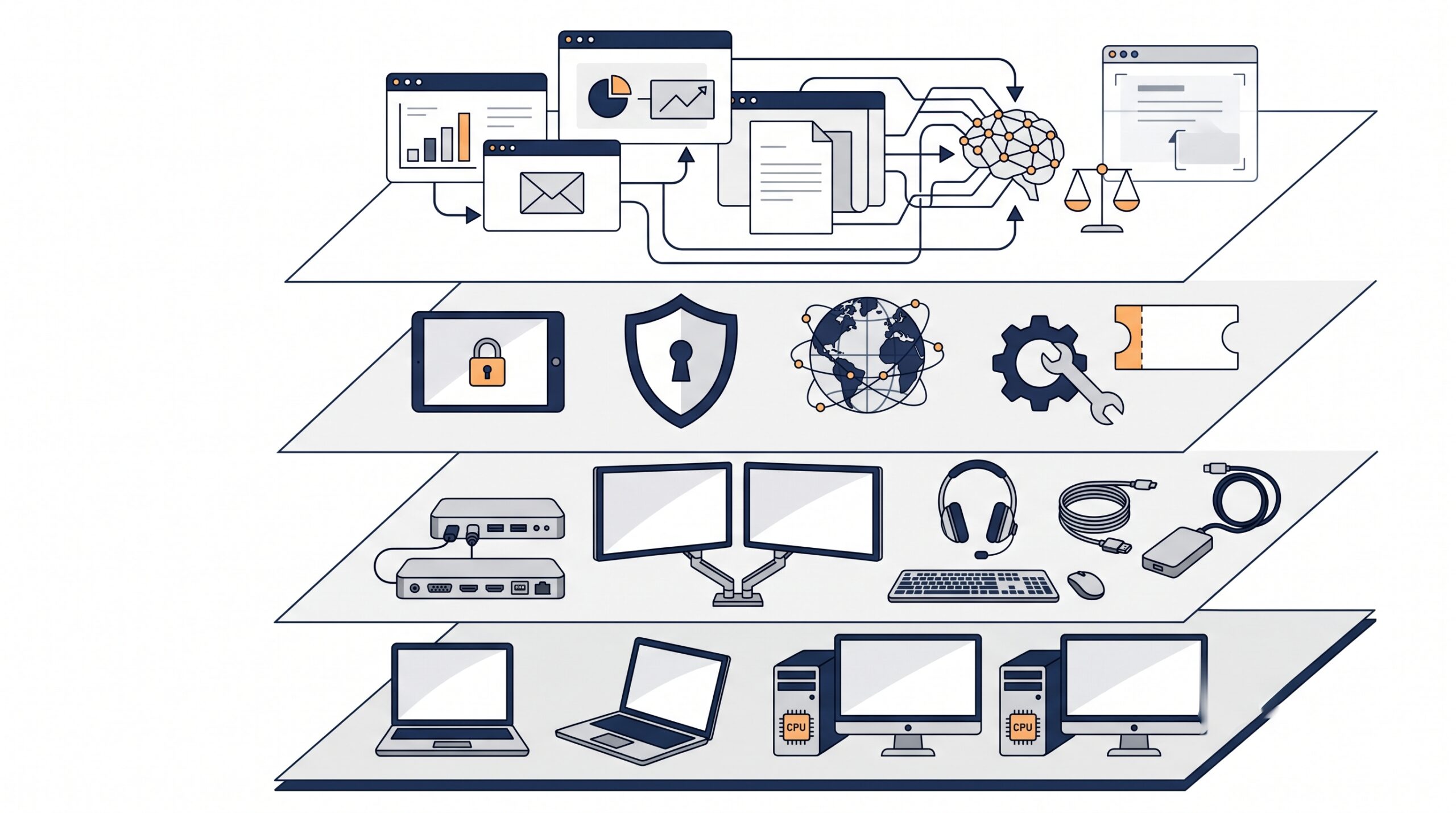
Every layer depends on the one below it.
A new AI tool cannot create reliable value if the underlying devices,
connectivity, support model, and workflows are inconsistent.
Expert Product Lab Framework • 2026
1. Baseline Hardware
Core computing devices, including laptops and workstations. This layer should
have limited variation to support predictable lifecycle management,
depreciation, security controls, and replacement planning.
2. Workspace Peripherals
The focus infrastructure: docks, displays, charging, keyboards, mice,
headsets, webcams, lighting, and cable management. This is where hybrid-work
friction is either removed or created every day.
3. Security and Support
Endpoint management, VPN access, extended warranties, device provisioning,
help-desk capacity, and the support processes that keep the first two layers
productive and secure.
4. Software and AI Workflows
SaaS platforms, enterprise copilots, and AI-enabled workflows. Each tool
needs an accountable workflow owner and success metrics tied to time,
quality, risk reduction, cost control, or revenue.
What to Standardize First
Standardization is not a restriction. It is a productivity system. Before adding
advanced tools, standardize the equipment and processes that create the most
friction when employees move between home, office, and shared workspaces.

Standardize the experience, not every individual preference.
A reliable hardware baseline makes moving between locations faster for
employees and easier to support for IT teams.
Enterprise Work Infrastructure • 2026
Docks and Chargers
Standardize compatible USB-C or Thunderbolt docking and charging options.
Employees should be able to sit at an approved desk and connect their work
setup through a simple, predictable process.
Audio and Video
For collaboration-heavy roles, a professional headset with a clear microphone
and a reliable webcam should be part of the baseline—not an afterthought when
meeting quality begins to fail.
System Images and Exceptions
Use standardized operating-system images, zero-touch provisioning where
appropriate, and a documented exception policy. Exceptions should have a
business reason, an owner, and a defined support path.
For a deeper framework on profiles, governed exceptions, and support reduction,
read
Hardware Standardization for Hybrid Work
.
When Premium Hardware Earns Its Cost
Premium devices and expanded setups should not be distributed as status perks.
They earn their place in the budget only when they remove a measurable bottleneck
for a specific work profile.
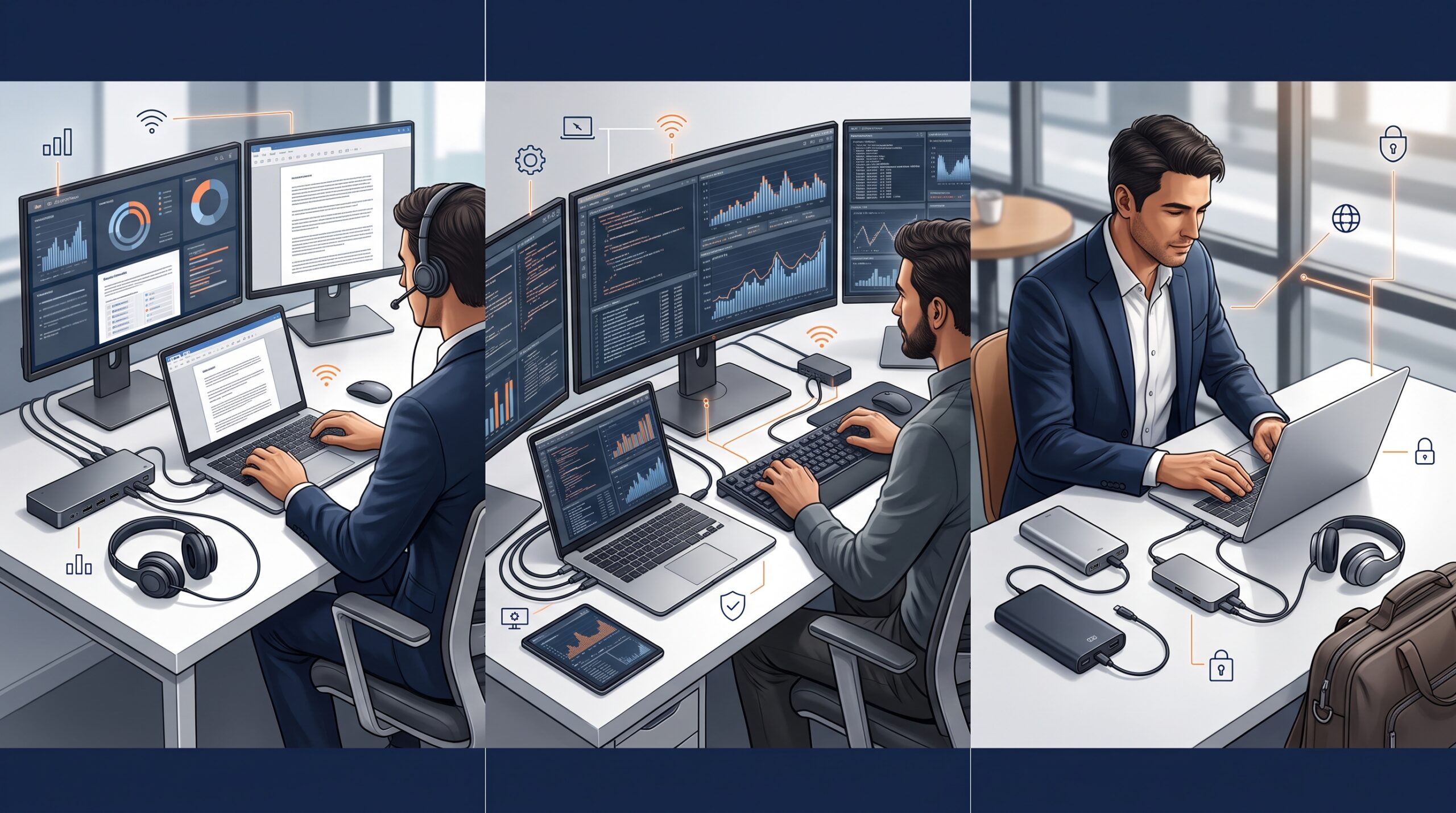
Spend according to the work performed.
A shared baseline controls complexity, while defined profiles direct
higher investment to work where performance, mobility, or screen space
produces measurable value.
Expert Product Lab Framework • 2026
Power Users and Analysts
Finance, analytics, and reporting teams may justify more memory, larger
display space, or an ultrawide monitor when those upgrades reduce repetitive
context switching and improve the speed or reliability of core work.
Engineering and Creative Teams
Developers, designers, and technical specialists may need higher-performance
workstations when build times, rendering, local testing, or complex creative
workloads are a demonstrated constraint.
Mobile and Field Teams
Employees who travel frequently may justify lighter devices, extended battery
life, durable designs, compact docks, and reliable communication accessories
when mobility is central to delivering their work.
For practical desk-level upgrades that support these profiles, explore
Top Desk Accessories for Better Focus at Work
.
What Enterprise Teams Should Stop Buying
A meaningful share of technology budgets is lost to purchases that fail to
deliver value at scale. The goal is not to eliminate experimentation; it is to
stop funding tools that add unmanaged complexity without solving a defined
business problem.
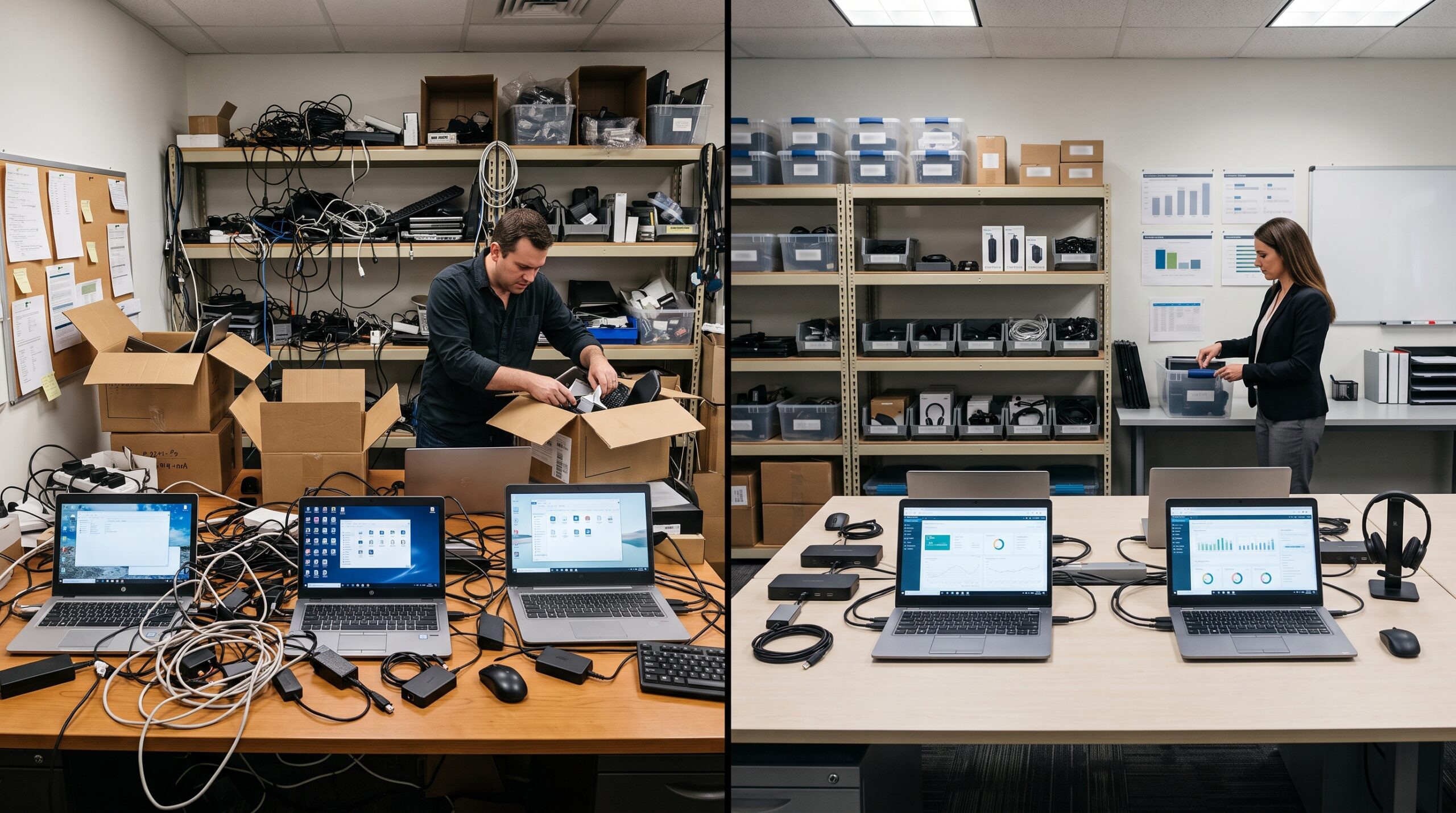
Technology sprawl is a budget problem before it becomes a support problem.
Consolidated purchasing and defined standards reduce waste while improving
reliability across the device fleet.
Expert Product Lab Visual Analysis • 2026
Uncertified Hubs and Adapters
Low-quality or untested accessories can create unstable charging, display
flicker, poor network performance, overheating, and inconsistent connectivity
across a hybrid device fleet.
Unsupported Individual Accessories
Avoid premium mice, keyboards, and peripherals that require unapproved
configuration software, fail to work with managed devices, or add a new
support burden without solving a clear need.
Redundant SaaS Licenses
Do not fund overlapping project-management, whiteboard, communication, or
collaboration platforms across separate departments without a clear
integration and ownership model.
AI Tools Without a Workflow Owner
Do not purchase generic copilots or AI agents without a defined workflow,
accountable adoption owner, security review, and success measures such as
hours saved, quality improvement, risk reduction, cost reduction, or revenue.
The Quarterly Technology Budget Audit
Review these questions every quarter to keep lifecycle cost, tool sprawl, and
recurring operational friction under control.
Hybrid work technology budget checklist:
- [ ] Which laptop model, dock, or accessory generates the highest volume of IT support tickets?
- [ ] How many paid work hours are lost each month to hardware failures, slow desk transitions, or collaboration issues?
- [ ] Is the device fleet replaced through a predictable lifecycle, such as 36 or 48 months, rather than only after failure?
- [ ] Are software and AI licenses actively used in defined workflows, or were they abandoned after initial adoption?
- [ ] Is total cost of ownership documented by work profile, such as knowledge worker, analyst, developer, or field employee?
- [ ] Does every major technology purchase have an owner, a support model, and an outcome that can be reviewed?
Optimize the AI Return Layer
Once the hardware baseline and workspace infrastructure are under control, the
next priority is governing advanced software investments. AI tools should improve
a known workflow—not become another disconnected subscription.
Explore the EPL ROI Strategy Hub
Connect technology spending with operational outcomes through practical
frameworks, scenario planning, and enterprise-focused ROI analysis.
-
Enterprise AI Budgeting: 4 Traps That Destroy ROI
Identify the common budgeting mistakes that lead to tool sprawl,
weak adoption, and unmeasured AI spending.
-
AI Budget Scenario Planner for Enterprise Teams
Model potential AI investments and compare their expected cost,
efficiency impact, and financial trade-offs.
-
Enterprise Work Setups: Building Focused Environments
Build reliable, ergonomic work environments across home, office,
and hybrid locations.