
Strategic ROI layer: Structuring an AI budget requires a granular understanding of infrastructure, software ecosystems, and technical debt. To see how autonomous tools integrate into a wider enterprise stack at board level, read our comprehensive ROI Guide for CTOs 2026.
AI Infrastructure & Financial Architecture • 2026
Affiliate Disclosure: This site contains affiliate links for which Expert Product Lab may be compensated if you make a purchase. Our technical evaluations are based on database stability, architectural utility, and enterprise scaling logic.
The Enterprise AI Budgeting Framework: Beyond Tooling Licenses in 2026
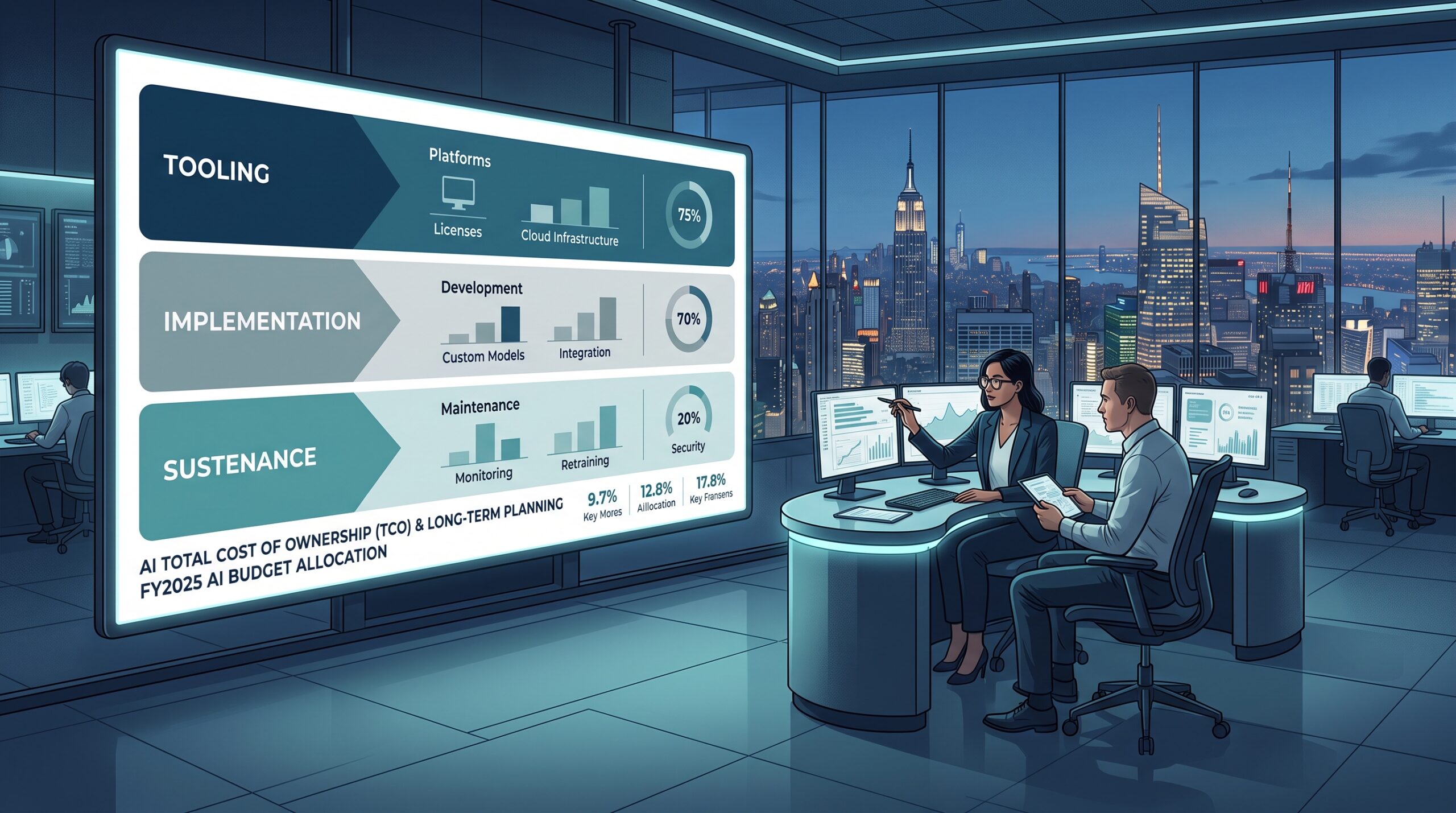
Board-level AI budgeting: Visualizing the three-layer structure of tooling, implementation, and sustenance as a financial architecture decision, not just a software price list.
SOURCE: EXPERT PRODUCT LAB ANALYSIS — INFRASTRUCTURE DIVISION
This article introduces an enterprise AI budgeting framework for 2026, designed to move leaders beyond blind license spending into full tooling, implementation and sustenance modeling.
Most corporate AI initiatives fail in the same place: the spreadsheet. In 2026, many organizations still approach artificial intelligence with a “blind budget” mindset—allocating capital exclusively for software licenses or per-user seat fees (“LLM pricing”) while entirely ignoring the underlying costs of implementation engineering, data preparation, pipeline maintenance, and change management.
An accurate AI budget is more of a strategic decision map than a simple software price list. When you treat AI integration as a one-time product acquisition, you invite massive technical debt and operational fragmentation. To build a highly resilient, ROI-positive automation ecosystem, enterprise leadership must analyze expenses through a strict three-dimensional framework: Tooling, Implementation, and Sustenance.
Table of Contents:
1. Enterprise AI Budgeting Framework: The 3 Core Pillars
Regardless of whether you are deploying a customer service agent, a financial automation script, or an advanced outbound sales pipeline, your cost modeling will always be driven by these three structural pillars:
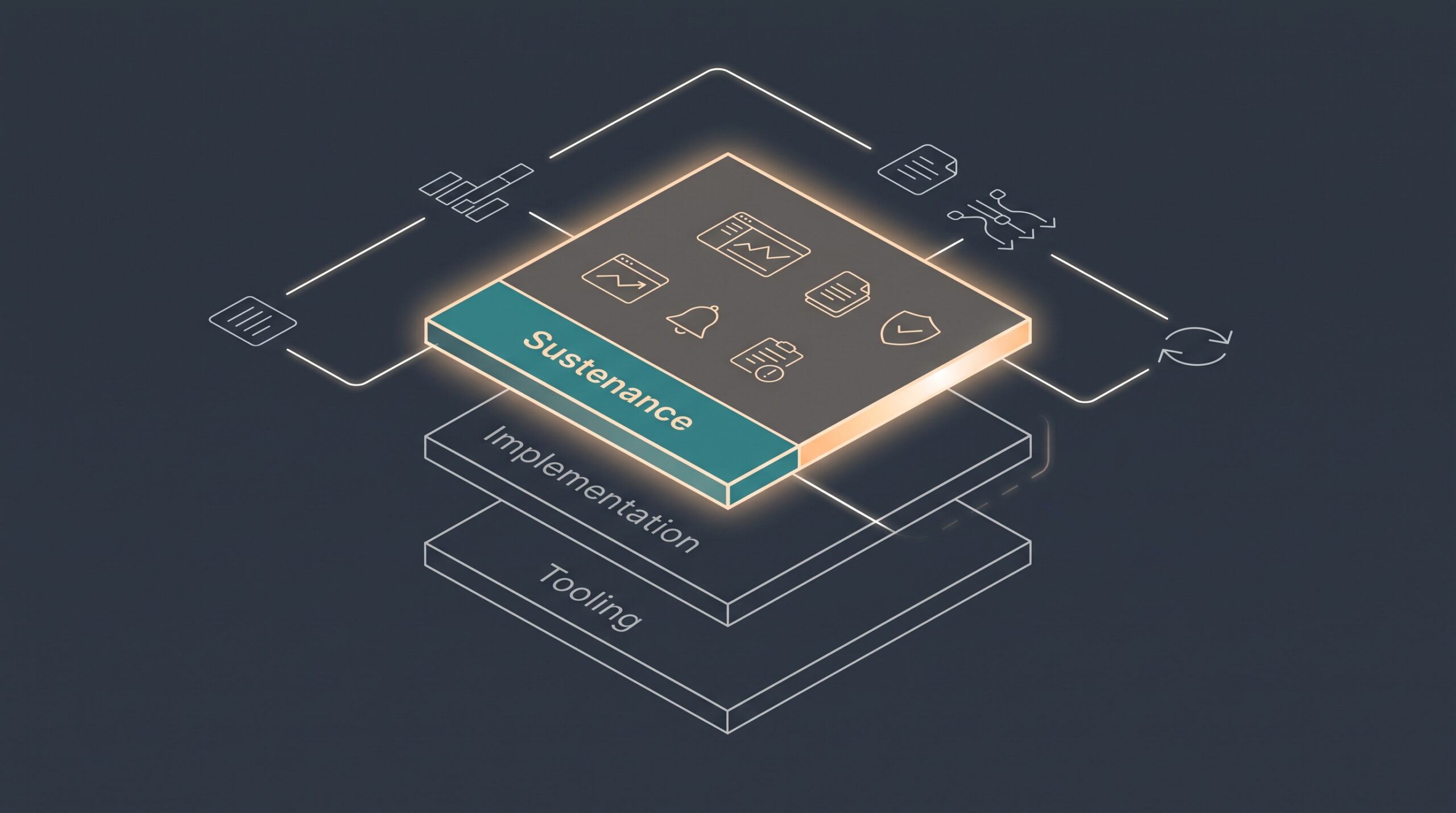
The sustenance layer: Tooling and implementation are only the foundation. Long-term maintenance, monitoring and retraining dominate the real TCO curve in mature AI systems.
SOURCE: EXPERT PRODUCT LAB ANALYSIS — INFRASTRUCTURE DIVISION
Pillar 1: Tooling Infrastructure (The Visible Layer)
Tools represent the most visible layer of your budget, but they are rarely the most expensive over time. This bucket encompasses foundational LLM commercial APIs, agentic orchestration platforms, middleware workflow tooling (e.g., Make, Zapier, n8n), dedicated vector storage databases, and security compliance wrappers.
- Licensing Dynamics: Seat-based pricing tiers versus consumption-based metrics (tokens processed, custom requests executed, total background automations run).
- Fixed vs. Variable Modeling: Foundational platform subscriptions alongside flexible data overages and third-party connector fees.
- Enterprise Add-ons: Advanced system audit logs, custom data retention models, secure enterprise single sign-on (SSO), and isolated storage containers.
The Golden Question: Which specific applications are mission-critical for the initial scope of our architecture, and which features can be treated as optional add-ons?
Pillar 2: Implementation Engineering (The Cost of Execution)
Implementation engineering is where typical corporate software projections collapse. Companies look at a clean platform license fee but fail to evaluate the sheer engineering friction required to move an agent out of a slide deck and into a production-grade workspace.
- Internal Resource Allocation: The true internal cost of product managers, backend developers, security engineers, and data analysts dedicated to the project.
- External Professional Services: Specialized systems integrator consultants, specialized contractors, and technical implementation partners.
- Discovery and Structuring: The raw engineering hours consumed by workflow mapping, prompt optimization, regression testing, custom API development, and data cleaning.
The Golden Question: What is the total engineering expense required to transform an abstract workflow blueprint into an operational, reliable system that our staff adopts every day?
Pillar 3: Long-term Sustenance (Preserving System Reliability)
Sustenance is the recurring cost of keeping your AI models optimized, secure, and contextually accurate over time. Once the excitement of a proof-of-concept wears off, someone must guarantee that your systems do not suffer from model degradation, data drift, or broken connections.
- Performance Optimization: Constantly auditing conversation history logs, re-engineering prompts, fine-tuning underlying models, and expanding internal knowledge vectors.
- Pipeline Resilience: Fixing brittle, broken third-party integrations, updating software dependencies, and adjusting to system API updates.
- Continuous Retraining: Training human staff on workflow changes, handling edge-case escalations, and maintaining detailed process documentation.
The Golden Question: How much capital must we dedicate to ongoing maintenance to ensure our automation pipelines do not degrade or fail as our business scales?
2. Operational Deep Dives Across Key Departments
To ground this budgeting logic in real-world application, we break down how these three pillars map across three distinct corporate units in 2026.
A. Customer Success & Support Agents
Modern customer support agents resolve complex tickets, retrieve data across siloed knowledge bases, and instantly orchestrate system schedules natively inside your database timeline.
- The Routine Shift: Human support reps shift away from answering repetitive level-1 questions and become advanced system administrators, stepping in only to resolve high-friction, sensitive edge cases.
- The Cost Distribution: Licensing covers agentic platform access and vector lookups. Implementation covers knowledge base cleanup, custom CRM connection engineering, and system rules configuration. Sustenance covers continuous intent-matching audits and tracking chat logs to eliminate hallucination vectors.
- Core Metrics: Deflected ticket volumes, first-contact resolution (FCR) velocity, and net human hours saved per week.
B. Marketing & Revenue Operations
In marketing environments, agentic systems manage end-to-end inbound contact pipelines, optimize lead enrichment parameters, and deploy contextual follow-up sequences across complex channels.
- The Routine Shift: Instead of manually parsing databases and copy-pasting tracking parameters, marketing teams spend their energy designing strategic messaging models and analyzing channel attribution data.
- The Cost Distribution: Licensing spans outbound communication credits, real-time data enrichment APIs, and database sync connectors. Implementation involves mapping out strict lead routing trees and configuring personalized conditional sequences. Sustenance tracks structural contact database hygiene and handles message delivery updates.
- Core Metrics: Marketing Qualified Lead (MQL) conversion rates, pipeline velocity acceleration, and customer acquisition cost (CAC) reduction.
C. Finance & Corporate Operations
Financial automation models parse unformatted invoicing data, handle cross-system reconciliation, flag payment anomalies, and build real-time budget forecasting frameworks.
- The Routine Shift: Accounts receivable staff transition from cross-checking spreadsheets and running manual invoice audits to managing complex capital deployment paths.
- The Cost Distribution: Licensing covers document extraction infrastructure and secure payment network APIs. Implementation is heavily weighted toward custom financial ERP software integrations, multi-factor validation flows, and cryptographic data security. Sustenance demands continuous compliance checking and variance audits.
- Core Metrics: Days Sales Outstanding (DSO) minimization, human transcription error reduction, and audit processing velocity.
| Department | Pillar 1: Tooling Costs | Pillar 2: Implementation Engineering | Pillar 3: Sustenance Overhead |
|---|---|---|---|
| Customer Success | Orchestration fees & vector credits | Knowledge base extraction & CRM links | Log optimization & intent verification |
| Marketing & RevOps | Enrichment APIs & data connectors | Sequence routing & attribution tracking | Database cleaning & delivery maintenance |
| Finance & Operations | Document extraction & ERP integrations | Security compliance & validation flows | Compliance audits & dependency checking |
3. Budget Scenarios: From Pilot Stage to Full Enterprise Scale
A strategic corporate rollout requires matching your financial capital allocation directly to your technical testing velocity. We suggest mapping out three progressive deployment scenarios:
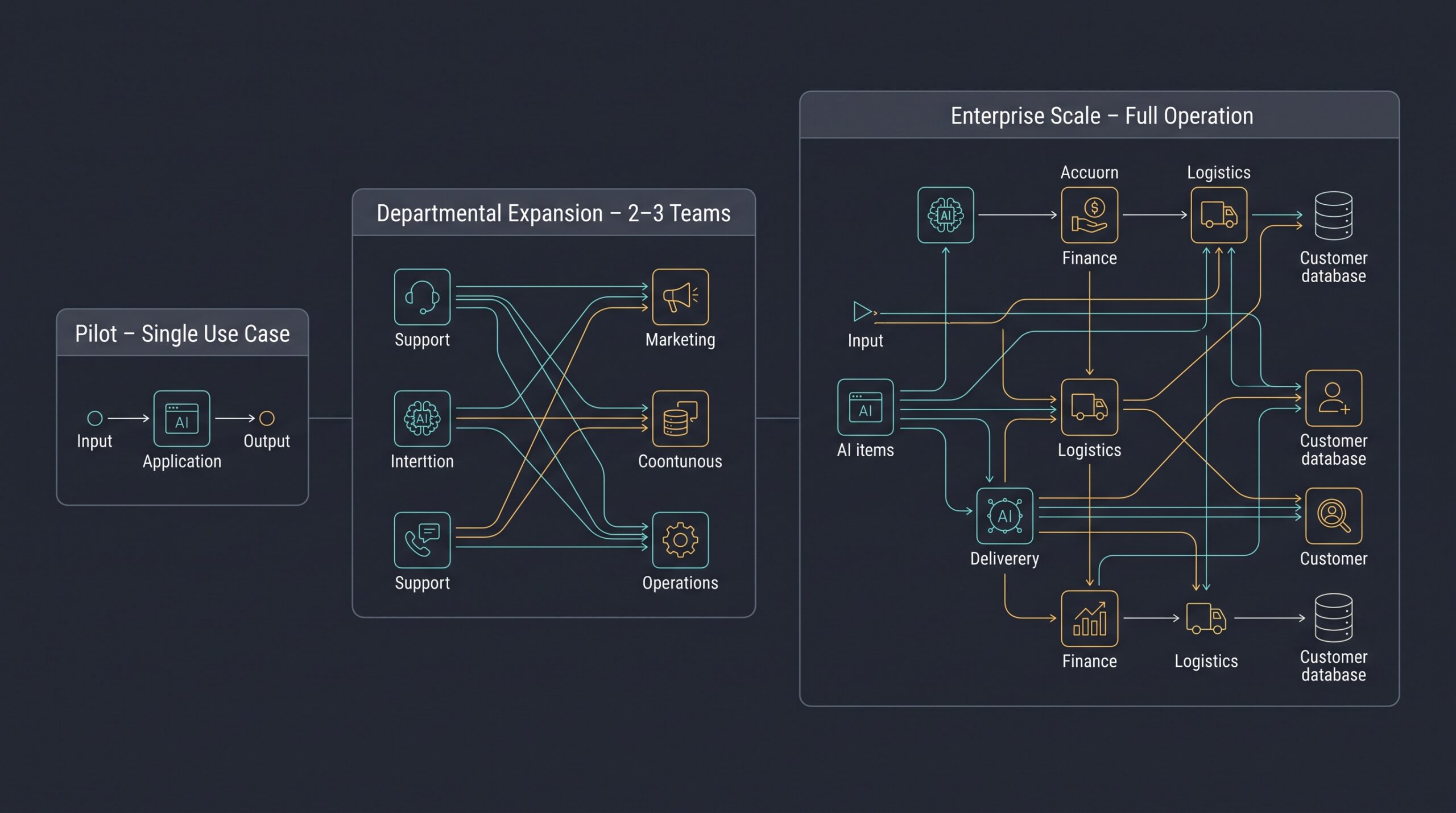
Scaling the automation stack: From a single-use-case pilot to a cross-department network of agents embedded across support, marketing, logistics and finance.
SOURCE: EXPERT PRODUCT LAB ANALYSIS — INFRASTRUCTURE DIVISION
Scenario 1: The Isolated Pilot (Single Use Case)
Deploy a hyper-focused agent to address a single, low-risk bottleneck (e.g., automated support triaging for one isolated software product). This scenario features lower tooling licensing, minimal data engineering complexity, and predictable boundaries. The goal here isn’t a massive transformation; it is establishing a clear technical baseline and calculating immediate workflow velocity.
Scenario 2: Departmental Expansion (2–3 Core Teams)
Once your pilot achieves its initial KPIs, expand the agent infrastructure to handle 2–3 complementary team environments (e.g., cross-functional lead qualification spanning marketing, outbound sales, and data enrichment). This phase requires scaling token volumes, designing advanced data routing trees, and investing heavily in robust data governance and user access management.
Scenario 3: Complete Enterprise Scale (Full Operation)
The final deployment stage transforms automation into a fundamental core infrastructure layer across the entire corporation. Systems are deeply embedded across your financial ERP, internal logistics, and customer facing databases. Tooling costs are fully variable and consumption-driven, while implementation shifts to long-term architectural oversight and predictive performance management.
CTO Financial Planning Tool: For each individual rollout scenario, technical leadership should run real-world headcount numbers and workload hours through our interactive Agentic AI ROI Calculator. This micro-tool converts personnel data and tool costs into direct monthly net savings projections before you open a spreadsheet.
4. The Final Approval Checklist
Before any departmental leader signs off on an automation budget or issues a software purchase order, force your technical steering committee to answer these three core questions:
- Which explicit process is being structurally optimized? If the team cannot point to a direct database field or communication flow, the proposal is an abstract software investment rather than an actionable architectural deployment.
- What is the complete Total Cost of Ownership across all three pillars? Ensure that your implementation engineering and ongoing sustenance line-items match or exceed your tool licensing projections. Never evaluate platform fees in a vacuum.
- What is the explicit timeline for project payback? Establish clear milestone expectations for capital recovery—whether that occurs através de redução imediata em horas de processamento de dados, menor volume de tickets de suporte ou aumento de velocidade de pipeline.
Test your AI budget scenario
Want to see how your stack of tools, implementation, and ongoing support
impacts your yearly AI budget? Use our
AI Budget Scenario Planner to simulate different investment levels.
For financial steering committees, AI investment should follow the same discipline used for traditional Total Cost of Ownership (TCO) modeling: every tooling line item must be mirrored by implementation and sustenance costs.


The focus on tooling for budgeting is interesting. How do you see that evolving in the next few years?
Pingback: Agentic Workflows: Why Low-Code is the Backbone of 2026 Enterprise
Great point – tooling is where a lot of the real leverage (and risk) sits.
Over the next few years, budgeting tools for enterprise AI and software will likely move in three directions:
Tighter integration with live usage data, so budgets aren’t static but adjust to how teams actually use tools month to month.
Stronger scenario planning baked in, letting leaders stress‑test “what if we add/remove this tool or vendor” before making commitments.
More governance layers, where finance, security, and ops can all see the same picture instead of working in separate spreadsheets.
The article pushes in that direction – away from one‑off spreadsheets and toward systems that make these trade‑offs visible. In your context, are you already using any tooling that pulls real usage data into budgeting, or is it ainda mais manual?
@Betslot_781 thanks for the question .